Reliable health information online is not identified by a polished design or a confident headline alone. A useful article shows where its claims come from, acknowledges limits and makes it clear who is responsible for the content. Before acting, pause long enough to understand what is actually being claimed. This matters especially when a post asks you to stop treatment or buy a cure.
Translate the headline into a specific claim
Ask what outcome is promised, for whom and under what conditions. A story about one person's experience is different from evidence about a treatment. A laboratory finding is not automatically a result in people. If the post never states the population or evidence clearly, treat the certainty of the headline with caution.
MedlinePlus advises questioning the source and purpose of health information and discussing its relevance with a healthcare professional.
Background guidance: MedlinePlus: Evaluating health information; NIA: Preparing for a medical appointment.
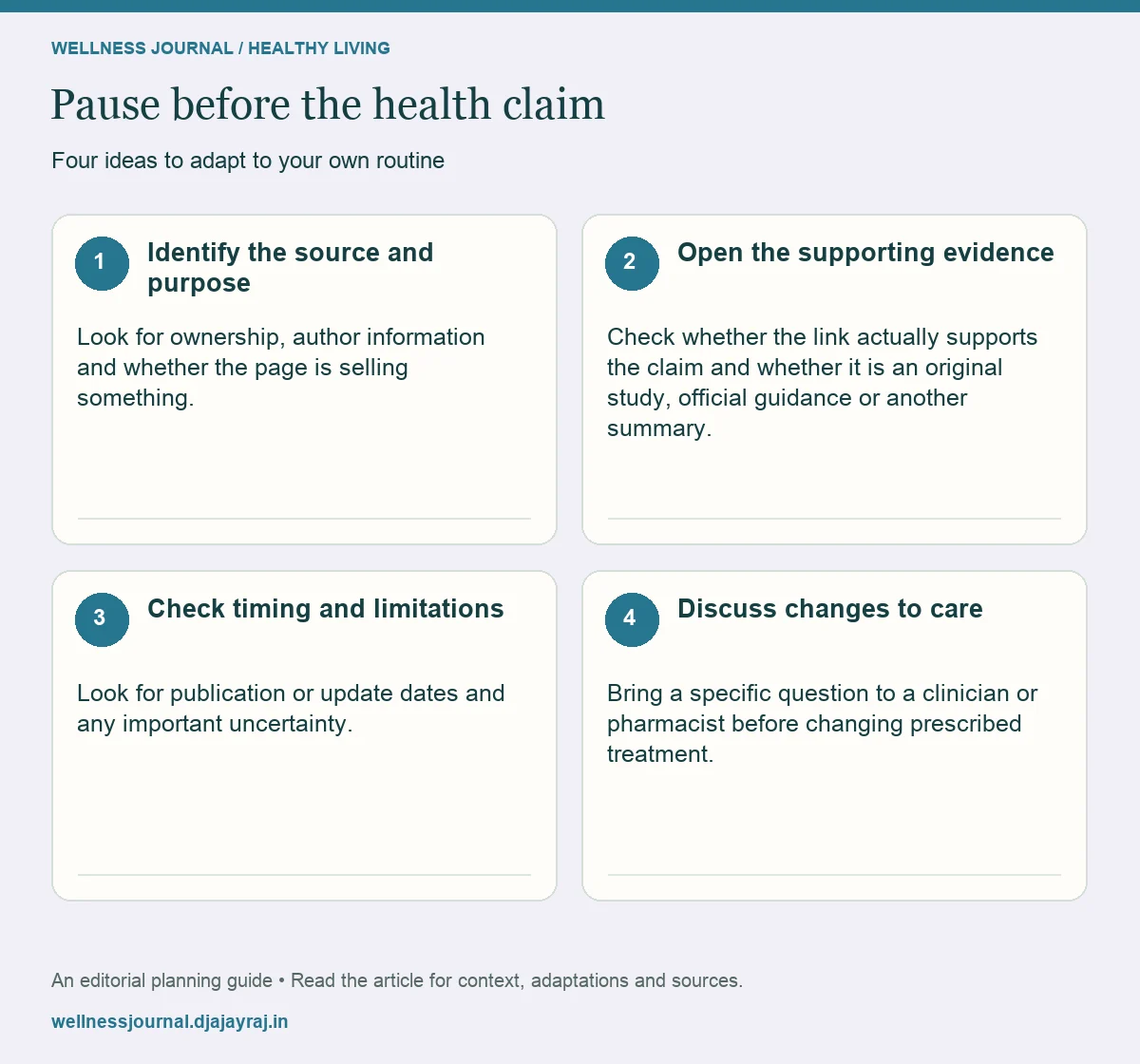
Four practical steps
Identify the source and purpose
Look for ownership, author information and whether the page is selling something. Advertising does not automatically make every statement false, but commercial interests should be visible and considered.
Open the supporting evidence
Check whether the link actually supports the claim and whether it is an original study, official guidance or another summary. A long list of references is not useful if the references concern a different question.
Check timing and limitations
Look for publication or update dates and any important uncertainty. Current information can still be wrong, while older foundational information may remain useful. The date is one clue, not a complete verdict.
Discuss changes to care
Bring a specific question to a clinician or pharmacist before changing prescribed treatment. Do not stop medicine because a social post describes a frightening possibility without explaining your individual situation.
A quick credibility check
| Question | Useful sign | Reason to pause |
|---|---|---|
| Who is responsible? | Clear ownership and contact | No accountable source |
| What supports it? | Relevant evidence links | Testimonials only |
| What are the limits? | Uncertainty is explained | Guaranteed cure language |
| What does it ask me to do? | Reasonable next steps | Stop care or buy urgently |
Make it work for you
Keep sharing separate from investigating
You can save a link for later checking without forwarding it immediately. If a claim concerns someone else's health, avoid presenting it as a diagnosis or treatment instruction. A thoughtful question is more useful than an alarming message that leaves the recipient to sort out the evidence alone.
Ask what would change your mind
If the claim cannot be questioned because every contrary source is dismissed automatically, it is difficult to evaluate fairly. Look for evidence that could confirm or weaken the claim.
Quick checklist
- Read beyond the headline.
- Check relevant evidence and interests.
- Do not change care from a social post alone.
Common questions
Does a government link make the whole article correct?
No. The linked page must support the specific claim, and the article must represent it accurately.
Are personal stories useless?
They can describe experiences, but they do not establish how a treatment will work for everyone or whether it is safe for you.