
An energy journal can organise observations when tiredness is affecting your day. It is not a test of productivity or a way to prove that you need more discipline. Record a few practical details and use them when seeking care. Do not delay an appointment while collecting data, especially when symptoms are new, worsening or accompanied by other concerning changes.
Describe function rather than only a number
A score such as three out of ten can be useful, but a sentence adds context: you needed to stop during an ordinary task or felt sleepy while reading. Record what is different from your usual experience. Avoid assuming that a particular food, mood or schedule explains the problem without assessment.
NHS guidance notes that tiredness has many possible causes and treatment depends on the cause. Persistent unexplained fatigue deserves medical advice.
Background guidance: NHS: Tiredness and fatigue; NIA: Preparing for a medical appointment.
Four practical steps
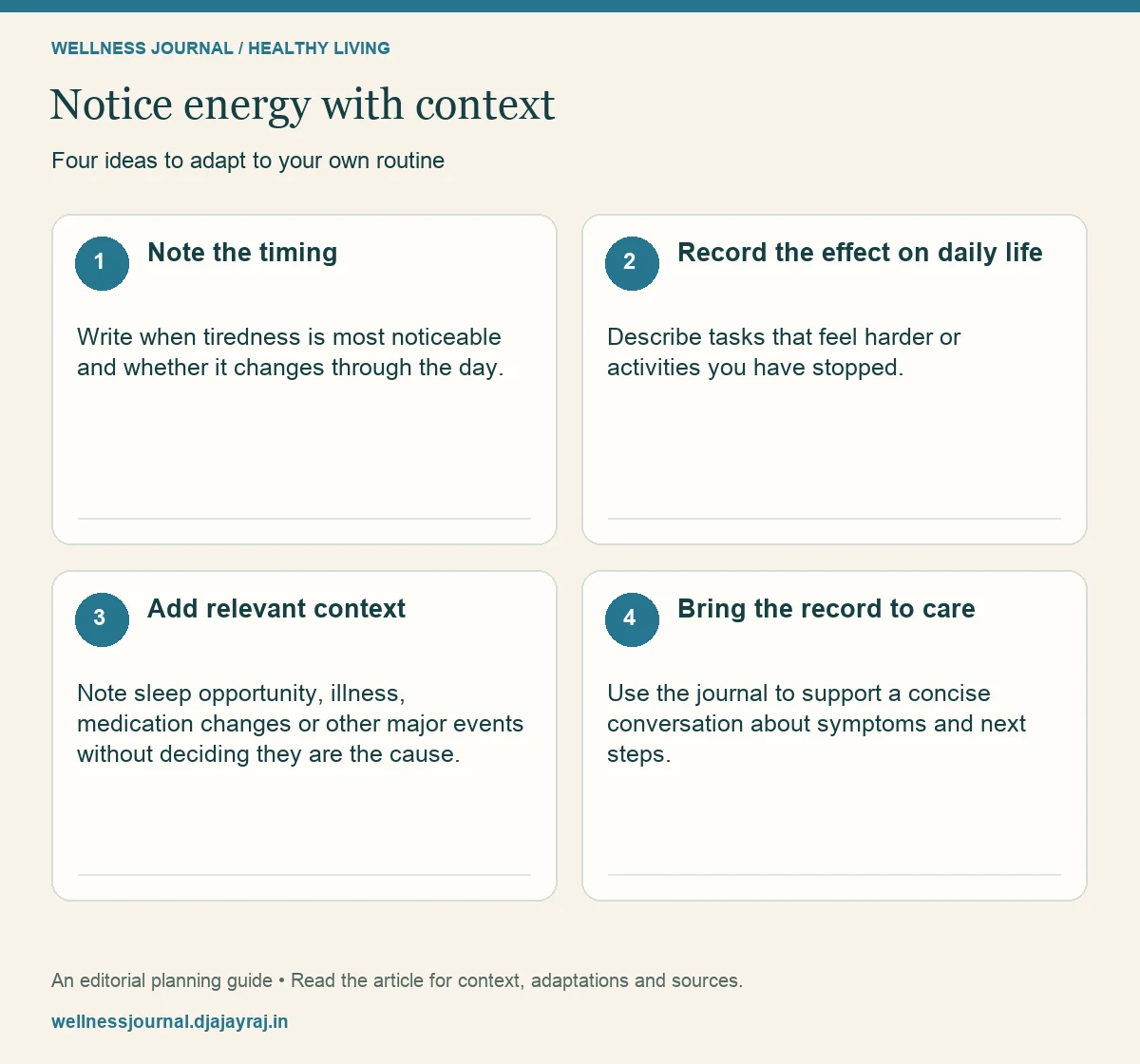
Note the timing
Write when tiredness is most noticeable and whether it changes through the day. Keep estimates simple. You do not need hourly monitoring unless a clinician specifically asks for it.
Record the effect on daily life
Describe tasks that feel harder or activities you have stopped. Include sleepiness separately when possible. These observations can help explain why the symptom matters.
Add relevant context
Note sleep opportunity, illness, medication changes or other major events without deciding they are the cause. Include information your clinician asks you to track.
Bring the record to care
Use the journal to support a concise conversation about symptoms and next steps. Ask what changes require urgent attention and whether further tracking would be useful.
A brief energy record
| Field | Example direction | Purpose |
|---|---|---|
| Time | Morning or afternoon pattern | Shows timing |
| Daily effect | Ordinary task became difficult | Shows impact |
| Context | Recent illness or schedule change | Provides background |
| Questions | What should I monitor next? | Supports care planning |
Make it work for you
Avoid pushing through to improve the score
The journal should not encourage you to exceed your limits or perform repeated tests of stamina. Some conditions need specific pacing or treatment advice. Follow professional guidance and seek urgent help for symptoms such as chest pain, severe breathlessness, collapse or other acute concerns.
Use one entry at a consistent time
A short daily note may be easier than continuous monitoring. Stop or simplify if recording becomes burdensome or increases anxiety.
Quick checklist
- Seek care for persistent unexplained tiredness.
- Record observations without self-diagnosis.
- Do not use the journal to pressure yourself.
Common questions
Can the journal tell me why I am tired?
No. It can show observations, but a clinician may need history, examination or tests to understand the cause.
Should I start supplements based on tiredness?
Do not assume a deficiency. Discuss symptoms and appropriate testing or treatment with a qualified professional.