A useful oral care routine is less about collecting products and more about making the basics easy to repeat. Put the tools you use within reach, choose a sequence that fits your morning and evening, and ask for help when a technique is difficult. This guide focuses on organisation; your dentist or hygienist can give advice for your teeth, gums, braces or dentures.
Make the routine easy to start
Notice the point where care gets skipped. Perhaps the tools are stored out of sight, evenings run late or cleaning between teeth feels awkward. Solve that particular obstacle. Keeping an appropriate tool visible can be more useful than buying several unfamiliar products. Follow hygiene and storage directions, and avoid sharing toothbrushes or personal cleaning tools.
NIDCR recommends brushing twice daily with fluoride toothpaste, cleaning between teeth regularly and attending dental check-ups suited to your needs.
Background guidance: NIDCR: Oral hygiene; NIDDK: Changing habits for better health.
Four practical steps
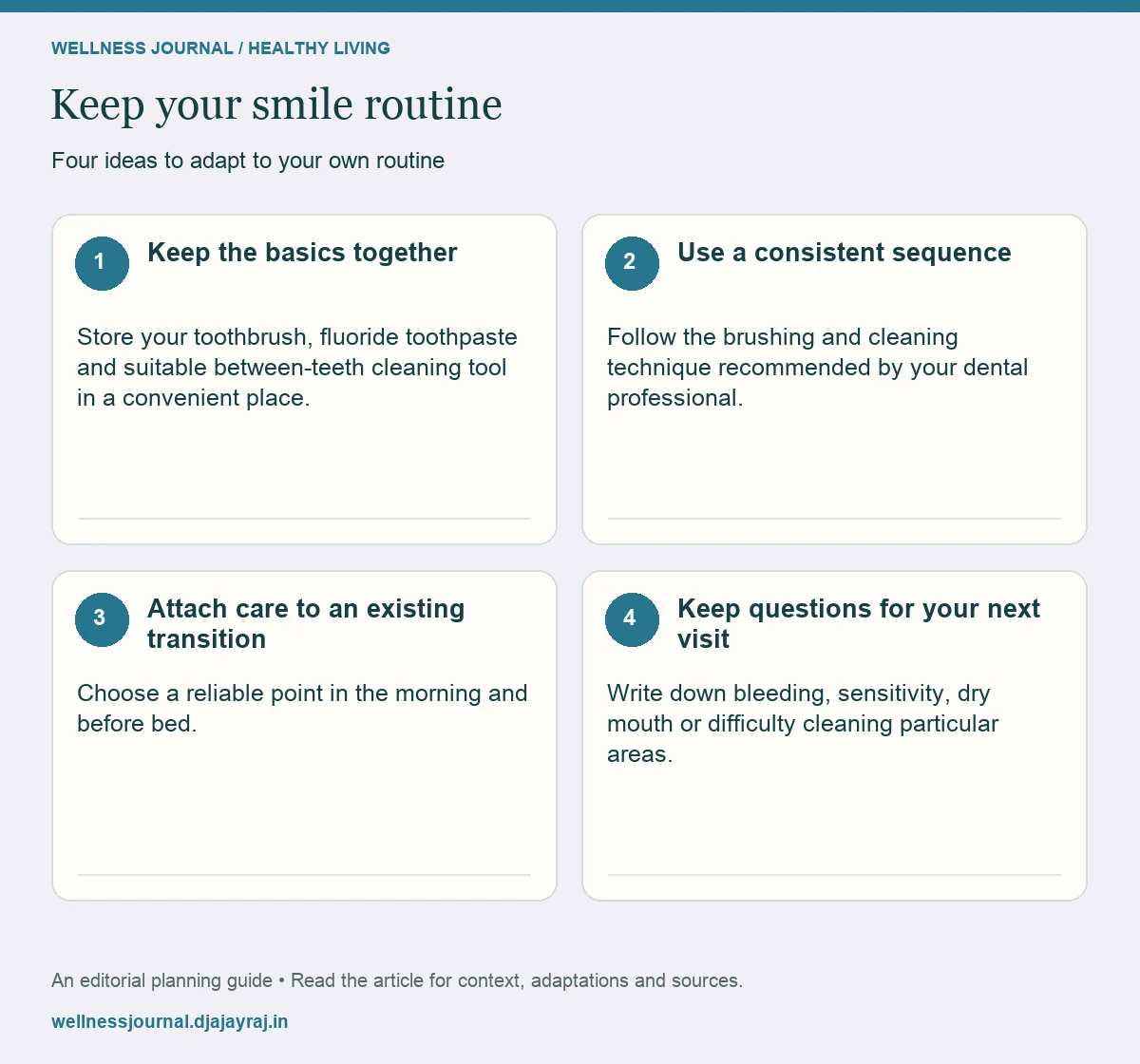
Keep the basics together
Store your toothbrush, fluoride toothpaste and suitable between-teeth cleaning tool in a convenient place. Check whether the brush is worn. If grip or coordination is difficult, ask a dental professional about tools that may be easier to handle.
Use a consistent sequence
Follow the brushing and cleaning technique recommended by your dental professional. Gentle, thorough care is more useful than aggressive scrubbing. If a movement hurts or a tool does not fit comfortably, ask for a demonstration rather than forcing it.
Attach care to an existing transition
Choose a reliable point in the morning and before bed. Do not wait until you are so tired that the routine becomes a negotiation. A reminder beside another evening task can help without requiring a detailed habit-tracking app.
Keep questions for your next visit
Write down bleeding, sensitivity, dry mouth or difficulty cleaning particular areas. Tell the dentist about relevant medicines and health changes. A short specific list makes it easier to get advice that addresses the actual problem.
Solve the obstacle you have
| Obstacle | Practical adjustment | Who can help |
|---|---|---|
| Tools are hard to find | Keep a simple care station | Your own setup |
| Grip is difficult | Ask about adapted handles | Dentist or hygienist |
| Between-teeth cleaning is awkward | Request a demonstration | Dental professional |
| Bleeding or sensitivity persists | Arrange an assessment | Dentist |
Make it work for you
Plan for travel and late nights
Keep a small travel kit with suitable versions of the tools you use at home. Restock it after a trip so it is ready next time. On a late night, complete the essential routine rather than adding optional cosmetic steps. Mouthwash or a fresh taste should not be treated as a substitute for the care your dental professional recommends.
Make the next appointment question concrete
Instead of saying 'my routine is bad,' describe the difficulty: 'I cannot comfortably reach this area' or 'this tooth is sensitive when I drink.' Specific observations are easier to investigate.
Quick checklist
- Use fluoride toothpaste unless advised otherwise.
- Ask for help with difficult techniques.
- Arrange care for persistent pain, bleeding or other changes.
Common questions
Do I need every product advertised for oral care?
No. Your needs may be met with a simpler set of tools. Ask a dental professional which additions, if any, are useful for you.
Should I brush harder when my teeth feel unclean?
Aggressive scrubbing is not the answer. Use the technique and tools recommended for you, and ask for guidance if you are unsure.