Small habit cues can make a new action easier to remember because the reminder already exists in your day. You might place a book beside your usual chair or refill water after washing a cup. The useful part is the connection, not a promise that every habit can be installed instantly. Choose an action that fits the cue and remains manageable on an ordinary busy day.
Use a cue you can actually observe
After breakfast is clearer than sometime in the morning, but only if you regularly eat breakfast. Choose a moment that really occurs in your life. A cue can be an action, a place or a visible object. Avoid relying on a feeling such as motivation, which may not arrive when you planned to begin.
NIH habit guidance discusses patterns, cues and planning. No fixed number of days guarantees that a new behaviour becomes automatic.
Background guidance: NIH News in Health: Creating healthy habits; NIDDK: Changing habits for better health.
Four practical steps
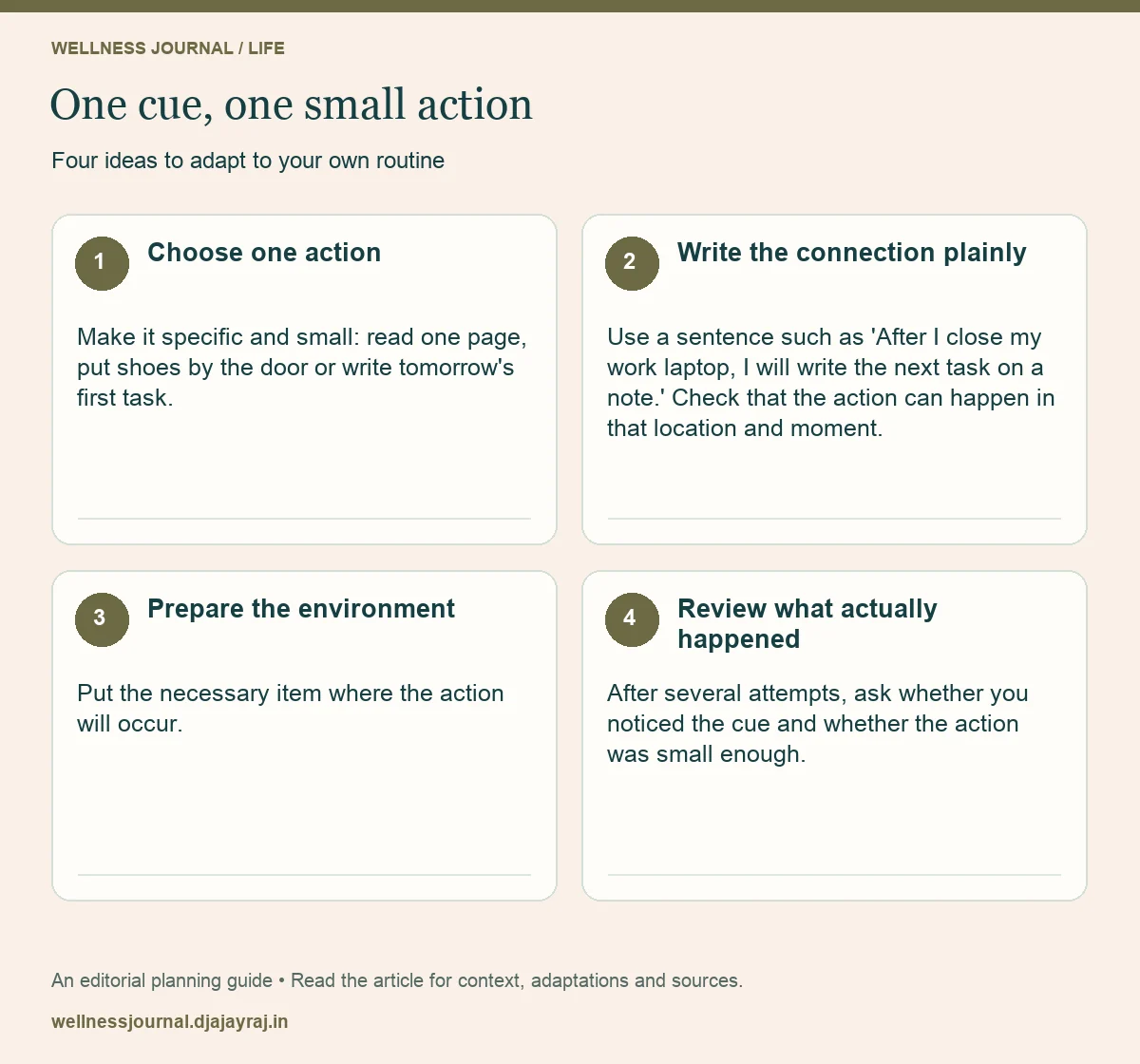
Choose one action
Make it specific and small: read one page, put shoes by the door or write tomorrow's first task. Avoid combining several new behaviours into one promise. A single action is easier to connect to a single cue.
Write the connection plainly
Use a sentence such as 'After I close my work laptop, I will write the next task on a note.' Check that the action can happen in that location and moment. A cue should not require an inconvenient detour.
Prepare the environment
Put the necessary item where the action will occur. If the book is in another room or the notebook is buried in a drawer, the cue may arrive without the tools. Reduce the physical effort of starting.
Review what actually happened
After several attempts, ask whether you noticed the cue and whether the action was small enough. Change one part if needed. A missed attempt is information about the design, not proof that you cannot build habits.
Turn a vague intention into a cue
| Vague intention | Observable cue | Small action |
|---|---|---|
| Read more | After sitting in the evening chair | Read one page |
| Prepare for tomorrow | After closing work | Write the next task |
| Keep essentials organised | After arriving home | Put keys in one place |
| Make movement easier | After changing clothes | Set out suitable shoes |
Make it work for you
Choose a restart rule
Decide what happens after a missed attempt: use the next normal cue and do the small version. Avoid adding a punishment or doubling the action. If the cue disappears because your schedule changes, choose a new cue rather than trying to force the old one. The design can evolve as your life changes.
Keep the action small after an easy day
Resist expanding immediately because the first attempt felt simple. Repeat the connection until you know it fits. You can always do more by choice without changing the minimum commitment.
Quick checklist
- Use a cue that occurs reliably.
- Keep tools within reach.
- Review the setup before blaming willpower.
Common questions
Will the habit become automatic in 21 days?
There is no universal deadline. The behaviour, context and person all matter. Focus on a workable pattern rather than a countdown.
Can I build several habits at once?
You can, but starting with one makes it easier to see what helps or gets in the way. Add complexity only when useful.