A weekly review routine can help you make decisions about unfinished work and upcoming commitments. It should not become a long ceremony for counting everything you failed to do. Look at what happened, what still matters and what can change. The useful outcome is a clearer next week, including things you choose not to carry forward.
Review the plan against real conditions
Notice unexpected demands, health, energy and support as well as completed tasks. A plan made before a difficult week may no longer be appropriate. Treat the review as a chance to update assumptions. Avoid automatically moving every unfinished item into the next week without checking whether it remains necessary.
Planning and prioritising appear in habit and self-care guidance. A weekly review is an organising tool, not a measure of personal value.
Background guidance: NIH News in Health: Creating healthy habits; NIMH: Caring for your mental health.
Four practical steps
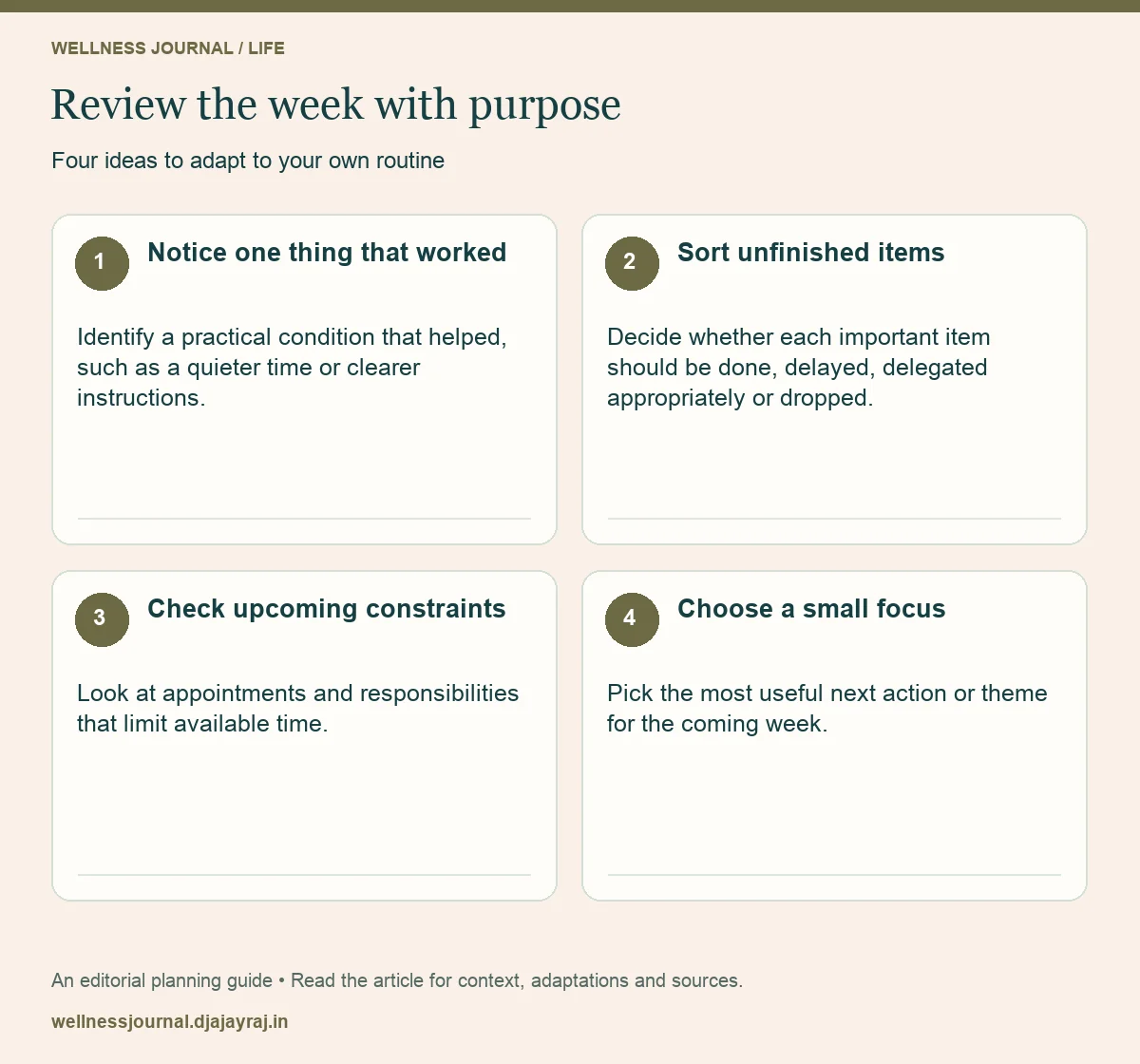
Notice one thing that worked
Identify a practical condition that helped, such as a quieter time or clearer instructions. Keep it specific so you can repeat it. This is more useful than a vague verdict that the week was good or bad.
Sort unfinished items
Decide whether each important item should be done, delayed, delegated appropriately or dropped. You do not need to preserve a task simply because you once wrote it down.
Check upcoming constraints
Look at appointments and responsibilities that limit available time. Leave room for transitions and ordinary needs. A realistic plan includes capacity, not just deadlines.
Choose a small focus
Pick the most useful next action or theme for the coming week. Keep the list short enough that it can guide decisions when new requests arrive. Avoid declaring everything a priority.
Four questions for a useful review
| Question | What it produces | Avoid |
|---|---|---|
| What worked? | A repeatable condition | Vague self-praise or criticism |
| What still matters? | A shorter current list | Automatic carry-over |
| What is coming? | A realistic capacity picture | Ignoring fixed commitments |
| What is next? | A clear focus | Too many priorities |
Make it work for you
Set a stopping rule
Use a brief time window or a defined set of questions. If a task requires detailed planning, schedule that separately rather than letting it consume the review. You can finish with some uncertainty. The review should make the week easier to enter, not become the largest task of the weekend.
End with one visible next action
Put it where you will see it at the relevant time. A review hidden in a long document is less useful than a small decision that reaches the next workday.
Quick checklist
- Include context and capacity.
- Drop tasks that no longer matter.
- Finish with a small clear focus.
Common questions
Should I review every area of life?
Only if that helps. A narrow review of the area causing friction may be more manageable.
What if the week was difficult?
Use the review to reduce demands and identify support. It does not need to become a performance assessment.