You can reduce daily decisions by deciding some ordinary things in advance. A usual breakfast, a place for keys or a standard shopping list can save repeated searching and debating. Defaults are useful when they make life easier and remain easy to change. They should not become rigid rules that ignore appetite, weather, health or what you actually want today.
Find the choice you repeat without enjoying
Notice a decision that consumes attention but rarely benefits from a fresh debate. It might be what to pack for work, where to store a document or which simple lunch to make. Avoid starting with a major life decision. The best first default solves a small recurring inconvenience and produces an obvious practical benefit.
Planning and prioritising are common elements of habit and self-care guidance. Defaults are practical conveniences, not a cure for persistent exhaustion.
Background guidance: NIH News in Health: Creating healthy habits; NIMH: Caring for your mental health.
Four practical steps
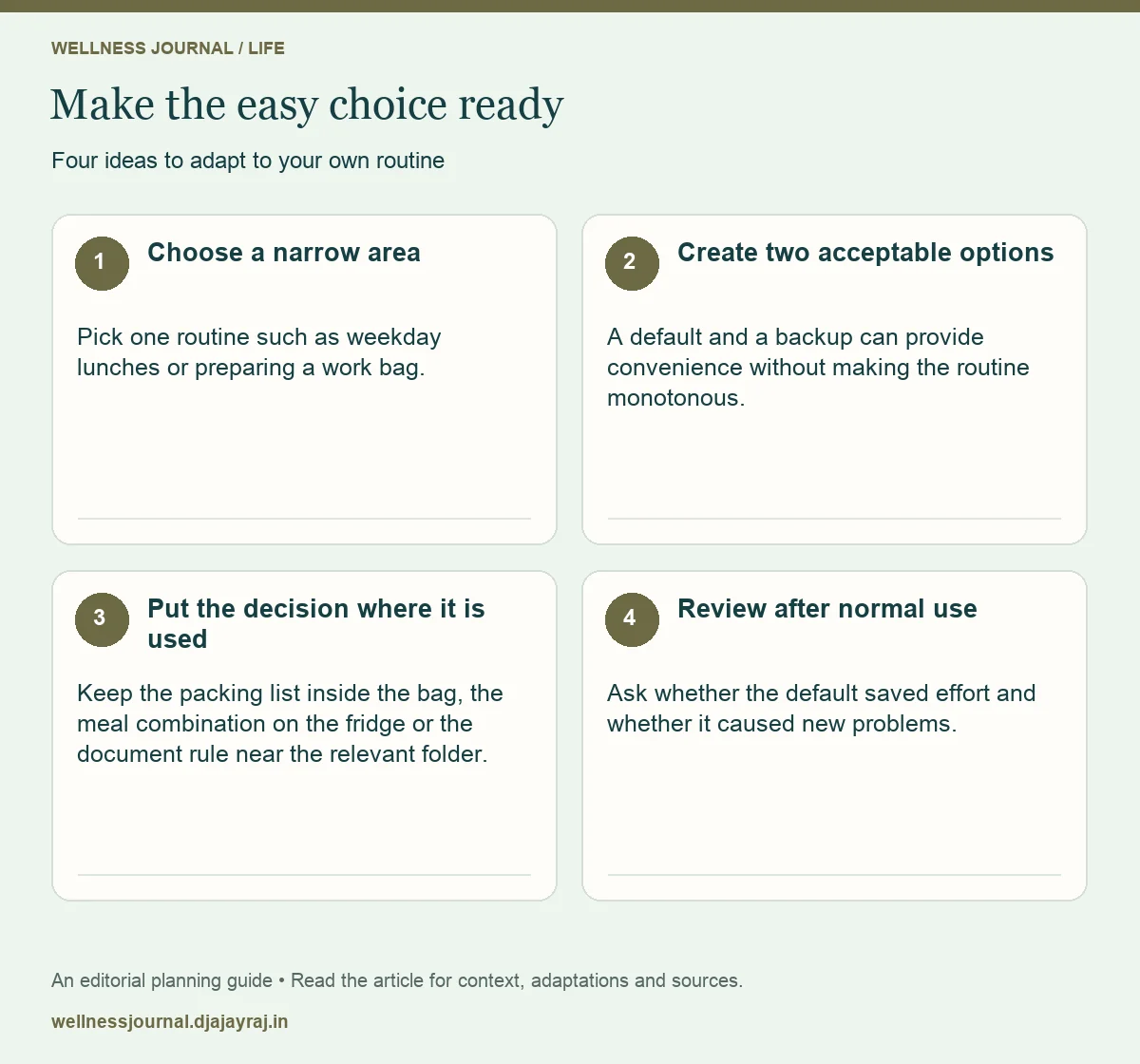
Choose a narrow area
Pick one routine such as weekday lunches or preparing a work bag. Keep the scope small enough to test. A plan to simplify everything can create more decisions than it removes.
Create two acceptable options
A default and a backup can provide convenience without making the routine monotonous. Choose options you already like and can maintain. The backup should work when the usual ingredient, time slot or item is unavailable.
Put the decision where it is used
Keep the packing list inside the bag, the meal combination on the fridge or the document rule near the relevant folder. A default stored in an app you never open is unlikely to help at the right moment.
Review after normal use
Ask whether the default saved effort and whether it caused new problems. Change it when circumstances change. A useful system is allowed to evolve; consistency does not require keeping an arrangement that no longer works.
Small defaults worth considering
| Recurring choice | Possible default | Backup |
|---|---|---|
| Work bag | Short essential-items list | Small emergency kit |
| Weekday lunch | Two familiar combinations | Suitable pantry option |
| Keys and wallet | One landing place | A travel pouch |
| Routine planning | One weekly check-in | Brief next-day review |
Make it work for you
Keep meaningful choices open
Not every decision should be automated. You may enjoy choosing meals, clothing or leisure activities, and that enjoyment matters. Use defaults for the parts that feel repetitive or frustrating. Leave room for preference and spontaneity. If ordinary decisions feel persistently overwhelming, consider whether workload, sleep or mental health needs broader support.
Write a reversible rule
Use language such as 'Usually I do this, unless…' rather than 'I must always…' This makes the default easier to use without turning an exception into a failure.
Quick checklist
- Start with one repetitive decision.
- Keep a practical backup.
- Change the default when it stops helping.
Common questions
Will defaults make life boring?
They do not have to. Use them for choices you do not enjoy repeating, and keep variety where it matters to you.
How many defaults should I create?
Start with one or two. Add another only when the first changes are useful and easy to maintain.