A good walk often starts with a few ordinary decisions: where to go, when to turn back and what the weather is doing. This outdoor walking checklist is for everyday routes, not remote hiking or extreme conditions. Keep the preparation proportional to the outing. A short neighbourhood walk needs less equipment than an unfamiliar route far from transport or help.
Choose a route with a comfortable exit
Look for a route you can shorten if necessary. Consider pavements, crossings, shade, seating and accessible toilets rather than distance alone. An attractive route is not automatically suitable if the surface is uneven or traffic is difficult. If you are trying somewhere unfamiliar, begin in daylight and leave enough time to return without rushing.
NHS walking guidance highlights comfortable supportive footwear. Fluid needs vary with factors such as heat and activity duration.
Background guidance: NHS: Walking for health; NHS: Water, drinks and hydration.
Four practical steps
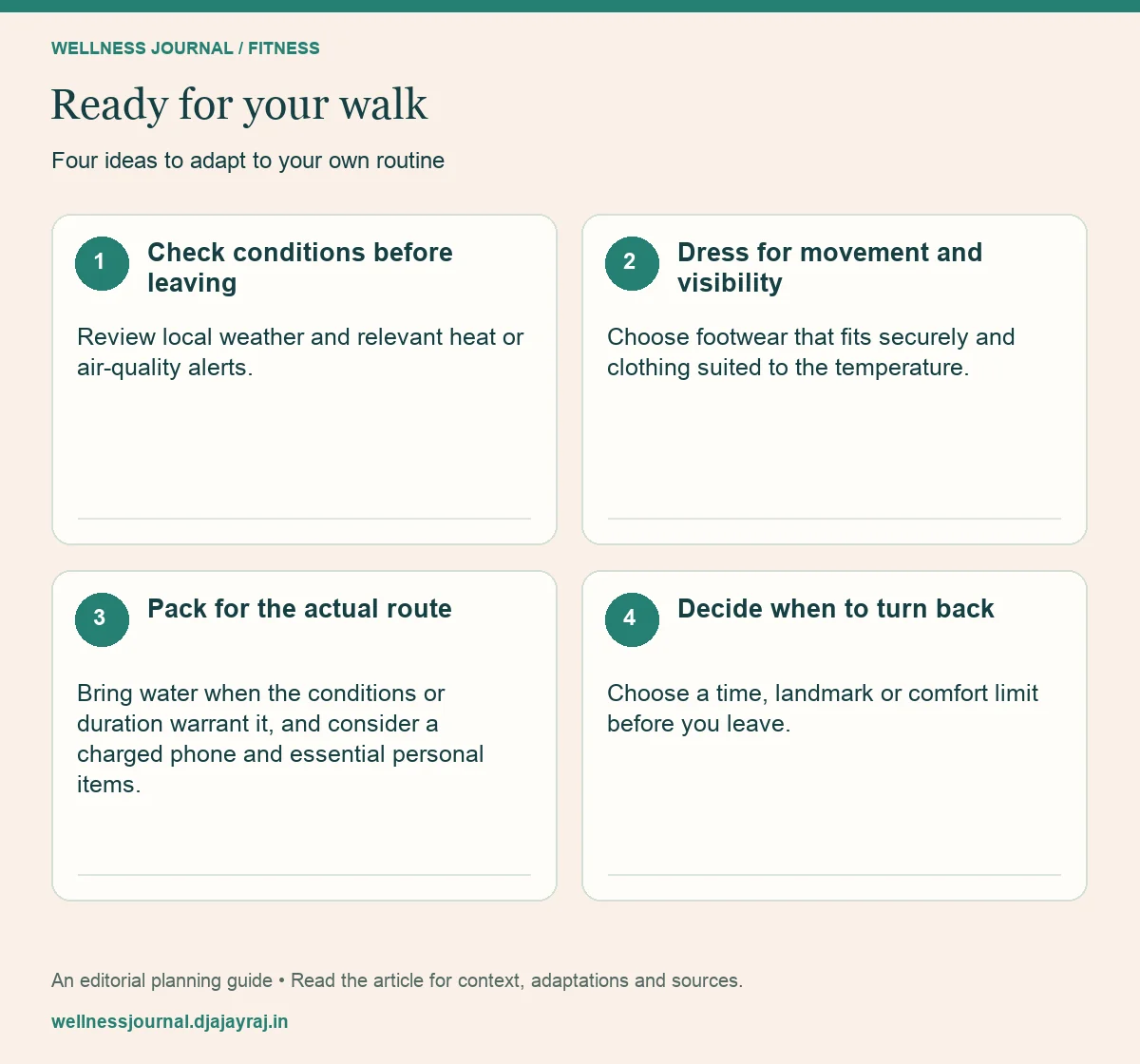
Check conditions before leaving
Review local weather and relevant heat or air-quality alerts. Adjust timing or choose an indoor alternative when conditions are unsuitable. Avoid assuming that your usual duration will feel the same in hot, humid or windy weather.
Dress for movement and visibility
Choose footwear that fits securely and clothing suited to the temperature. Make yourself visible around traffic and use appropriate sun protection. A new pair of shoes is best tested on a short outing before a long walk.
Pack for the actual route
Bring water when the conditions or duration warrant it, and consider a charged phone and essential personal items. Keep the load comfortable. Do not add equipment simply because a checklist makes the walk sound like an expedition.
Decide when to turn back
Choose a time, landmark or comfort limit before you leave. Turning back early is a useful decision when the weather changes or your feet begin to hurt. You do not need to complete a loop at the cost of comfort or safety.
Match preparation to the outing
| Route feature | What to consider | Simpler alternative |
|---|---|---|
| Hot exposed path | Timing, shade and water | Cooler indoor location |
| Uneven surface | Footwear and balance needs | Level paved route |
| Unfamiliar area | Navigation and return time | Shorter known loop |
| Limited seating | Your need for breaks | Route with resting places |
Make it work for you
Make the outing enjoyable
Choose one pleasant feature: a garden, a quiet street, a friend or a place to sit. Enjoyment makes a route worth repeating. You can leave headphones off when you need to hear traffic or other people. If you use audio, keep awareness of your surroundings and avoid making the phone the centre of the walk.
Keep a ready-to-go corner
Store the shoes and small items you actually use in one place. Remove anything that makes preparation feel excessive. The aim is to make an ordinary walk easy to start.
Quick checklist
- Choose a route you can shorten.
- Check weather and local alerts.
- Turn back when conditions or symptoms change.
Common questions
Do I need specialist walking shoes?
For ordinary short walks, comfortable supportive footwear may be enough. More demanding terrain can require different equipment and preparation.
Should I force the same distance every time?
No. Weather, energy and symptoms vary. Use the plan as a guide and change it when needed.