A workout cool down can be a short transition from exercise to the next part of your day. Ease the effort, notice how you feel and give yourself time to finish without rushing. It does not need to become a second session or a test of flexibility. Choose movements that fit the activity you did and any individual guidance you have received.
Reduce the effort before adding anything else
After an aerobic session, move at an easier pace when appropriate rather than immediately adding demanding exercises. After strength work, put equipment away safely and allow a calm transition. If you feel faint, unwell or have chest discomfort, stop and seek appropriate help; those symptoms are not a routine cool-down goal.
NHS resources describe cooling down with gradual relaxation and appropriate stretches. No routine guarantees that soreness or injury will be prevented.
Background guidance: NHS: Stretching after exercise; NHS: Exercise guidance and routines.
Four practical steps
Ease the pace
Use comfortable familiar movement for the transition. Keep breathing naturally. The duration depends on the session and your response, so do not treat a fixed timer as more important than how you feel.
Choose stretches carefully
If you stretch, use a comfortable range without bouncing or forcing. Skip positions that cause pain or are difficult to enter safely. A stretch from a video is not automatically suitable for an injury or medical condition.
Notice the response
Check whether discomfort is ordinary effort-related tiredness or something unusual. Do not use stretching to repeatedly test a painful area. Persistent or worsening symptoms deserve assessment rather than a more intense recovery routine.
Leave a useful session note
Record one detail that will help next time: the pace was manageable, a movement needed adjustment or the session was too long. Then move on. You do not need to analyse every minute of the workout.
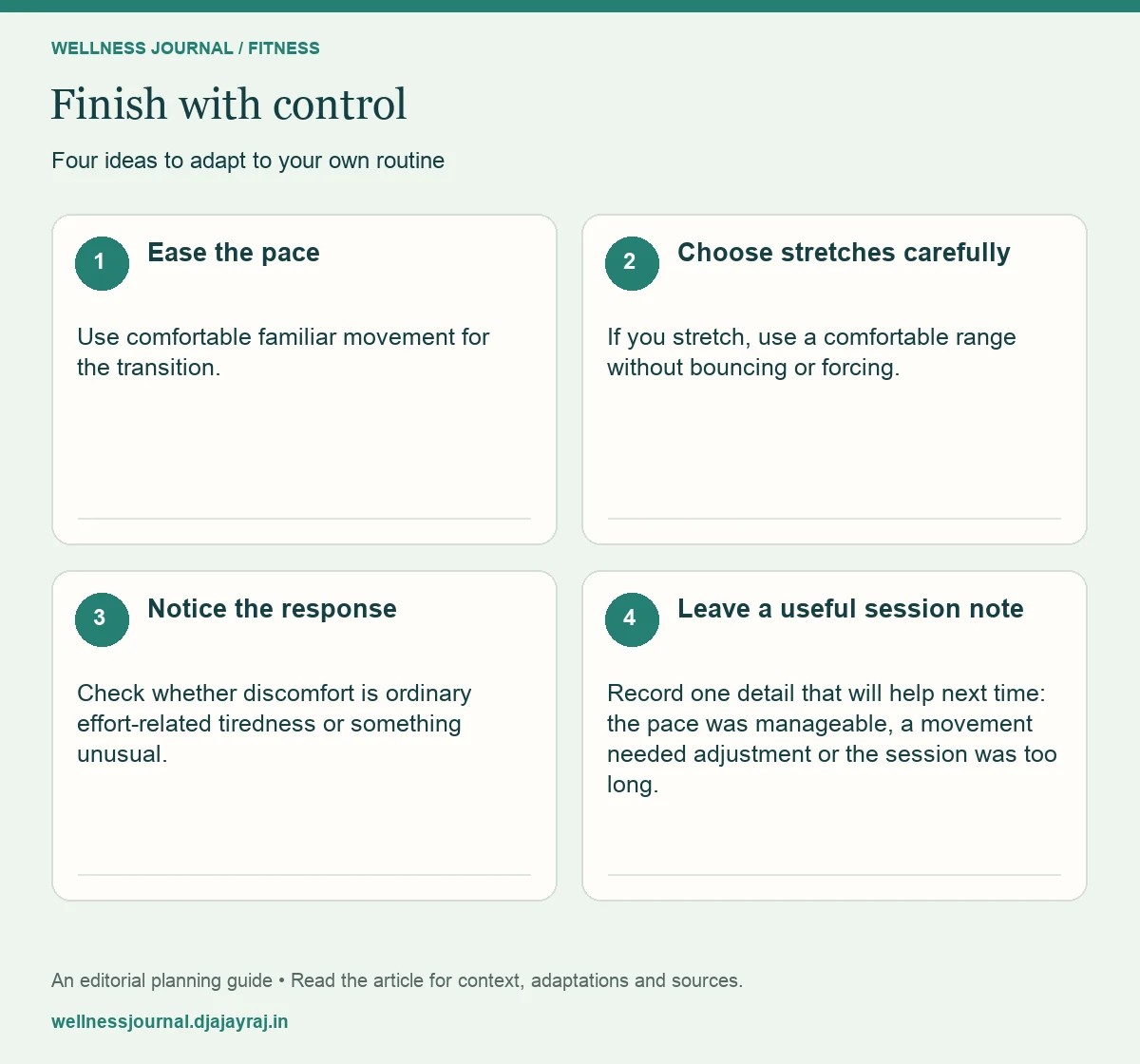
A simple finish to the session
| Part | Useful action | Keep it modest |
|---|---|---|
| Transition | Reduce effort gradually | No extra challenge |
| Optional mobility | Comfortable familiar stretch | No bouncing |
| Symptom check | Notice unusual discomfort | Do not push through |
| Next session | Write one useful note | Avoid over-analysis |
Make it work for you
Do not promise yourself a soreness cure
Soreness can occur even when you warm up and cool down sensibly. A cool-down is not a guarantee against injury or a way to erase an overly demanding session. Plan an appropriate workload, recovery and progression. If symptoms are severe, persistent or unusual, get advice rather than assuming they are normal training effects.
For a busy day
Allow a brief easy transition and put equipment away safely. Do not add a long ritual that makes exercise impractical. Keep the essential finish simple.
Quick checklist
- Ease effort appropriately.
- Stretch only within comfort.
- Seek care for concerning symptoms.
Common questions
Will stretching stop all soreness?
No. Avoid treating it as a guaranteed prevention method. Comfortable movement and appropriate training load are separate considerations.
Should a stretch hurt to work?
No. Pain is not the target. Reduce the range or stop and ask for guidance if needed.