Breathing for stress can begin with a small pause rather than a complicated counting pattern. You do not need to fill your lungs as much as possible or hold your breath. Find a supported position and notice what feels comfortable. Some people find attention to breathing helpful; others feel more anxious. You can stop or choose a different grounding activity.
Make comfort the first instruction
Sit or stand in a supported position and loosen anything that feels restrictive if practical. Keep your eyes open if you prefer. Let breathing happen normally before changing anything. The aim is not to produce a dramatic sensation. If you are breathless, dizzy or experiencing chest pain for an unexplained reason, do not assume stress is the cause.
NHS breathing guidance emphasises gentle, comfortable breathing without forcing it. A breathing exercise is not a substitute for medical or mental-health care.
Background guidance: NHS: Breathing exercises for stress; NIMH: Caring for your mental health.
Four practical steps
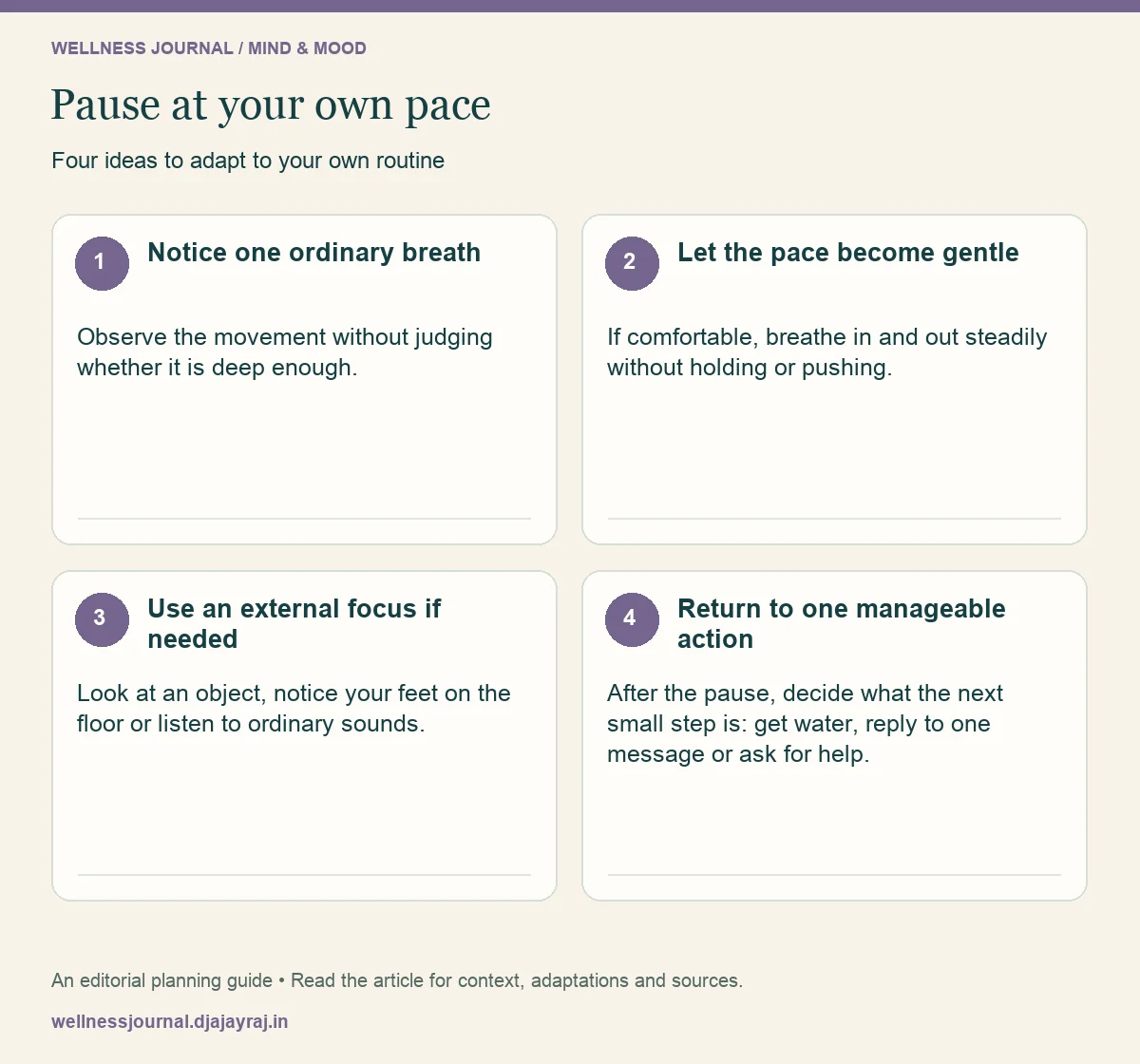
Notice one ordinary breath
Observe the movement without judging whether it is deep enough. You can place attention on the air at your nose or the movement of your body, whichever feels less effortful. There is no need to control every part of the breath.
Let the pace become gentle
If comfortable, breathe in and out steadily without holding or pushing. A quiet count may help, but you can leave counting out. Stop if the exercise causes dizziness, tingling, panic or discomfort.
Use an external focus if needed
Look at an object, notice your feet on the floor or listen to ordinary sounds. Focusing outside the body can be more comfortable for some people. Choosing another approach is a sensible adjustment, not a failure.
Return to one manageable action
After the pause, decide what the next small step is: get water, reply to one message or ask for help. The pause does not have to remove all stress before you continue. It can simply create a moment to choose.
Adapt the pause to your experience
| What you notice | Possible adjustment | Do not force |
|---|---|---|
| Counting feels helpful | Use an easy count | A rigid breath length |
| Breath focus increases anxiety | Look at an external object | Continued internal focus |
| You feel dizzy | Stop and breathe normally | Deeper or faster breathing |
| Stress remains intense | Seek support | A promise of instant calm |
Make it work for you
Practise outside the most stressful moment
If you want to try the exercise, begin during a relatively ordinary moment so you can see whether you like it. Keep it brief and comfortable. When stress is severe or persistent, practical support and professional care may be more important than a relaxation technique. Seek urgent help if you feel unsafe or have concerning physical symptoms.
Use a quiet transition
Try the pause between tasks rather than adding another alarm. One comfortable breath and a clear next action may be enough. You do not need to complete a fixed session.
Quick checklist
- Keep breathing gentle and unforced.
- Stop if symptoms worsen.
- Use appropriate care for persistent distress or physical symptoms.
Common questions
Should I hold my breath?
This gentle exercise does not require breath-holding. Keep the process comfortable and follow individual medical advice when relevant.
What if breathing exercises make me anxious?
Stop and choose an external focus or another activity. A professional can help you find approaches that suit you.