News overwhelm can happen when every spare moment becomes another check for updates. Staying informed matters, but constant checking does not always provide new or useful information. Choose what you need to know, where you will look and what you will do afterward. The aim is a more deliberate relationship with information, not pretending that difficult events do not affect you.
Separate necessary alerts from habitual checking
Some information is immediately relevant to safety, travel or work. Other updates can wait for a chosen time. Keep necessary local alerts available and review the rest of your notification settings. A general wellbeing routine should never encourage ignoring emergency instructions or information you need to act safely.
Self-care guidance includes setting priorities and using supportive coping strategies. A news routine can manage attention but cannot remove real-world uncertainty.
Background guidance: NIMH: Caring for your mental health; NIH: Emotional wellness toolkit.
Four practical steps
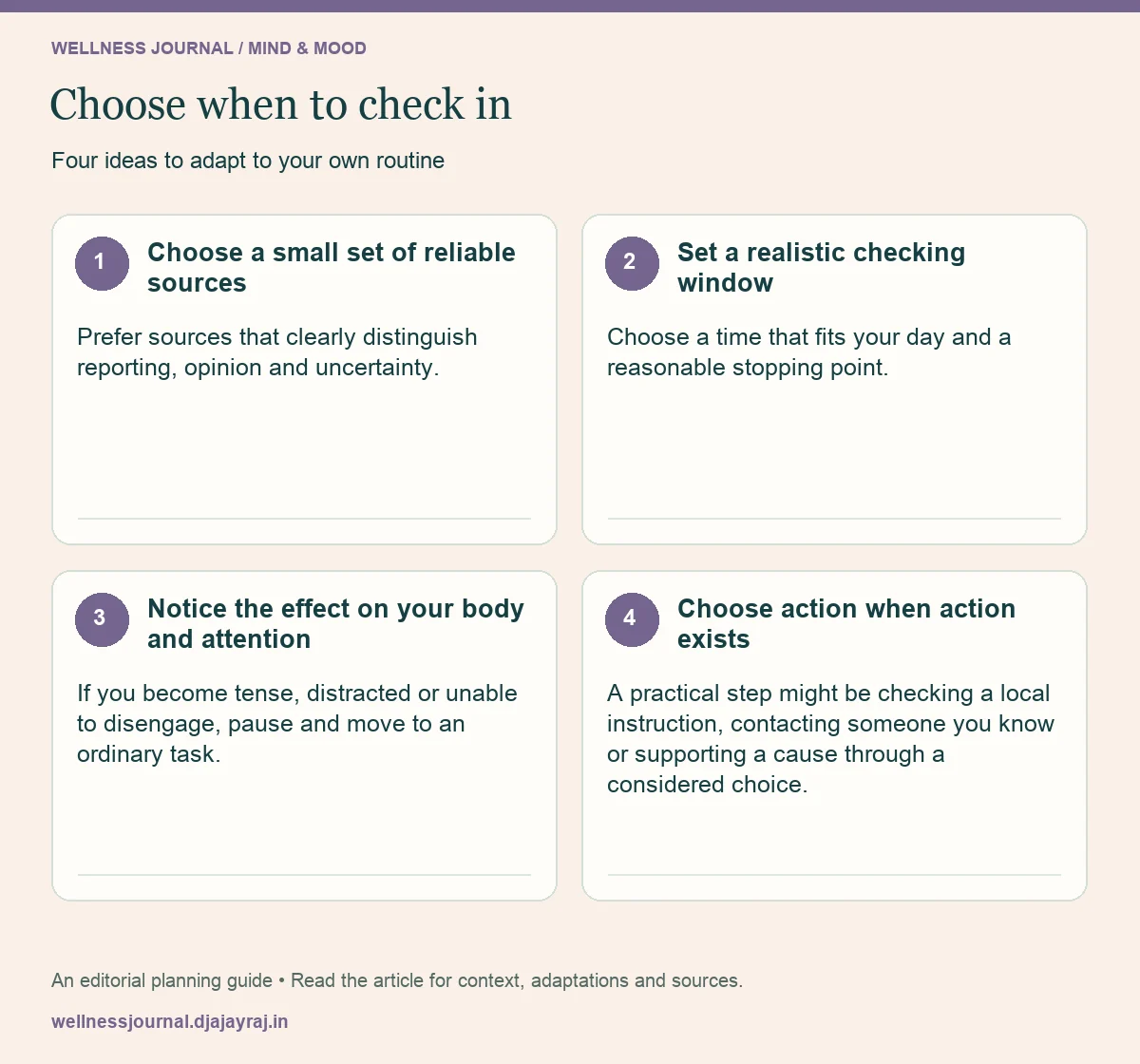
Choose a small set of reliable sources
Prefer sources that clearly distinguish reporting, opinion and uncertainty. For health or emergency instructions, use relevant official authorities. Avoid treating repeated posts as independent confirmation when they all refer to the same original claim.
Set a realistic checking window
Choose a time that fits your day and a reasonable stopping point. The plan can change during a developing event. What matters is noticing whether you are learning something useful or simply repeating the same scan.
Notice the effect on your body and attention
If you become tense, distracted or unable to disengage, pause and move to an ordinary task. You do not need to finish every thread. Consider whether checking near bedtime is interfering with the time you want to rest.
Choose action when action exists
A practical step might be checking a local instruction, contacting someone you know or supporting a cause through a considered choice. If no useful action is available, you are allowed to stop consuming updates for a while.
Give each information type a place
| Information | How to handle it | Useful boundary |
|---|---|---|
| Emergency alert | Keep accessible | Act on relevant instructions |
| Routine news | Use chosen sources and times | Stop after a useful review |
| Unverified claim | Check the original evidence | Avoid immediate sharing |
| Repeated distressing material | Pause or limit exposure | Seek support if needed |
Make it work for you
Keep connection outside the feed
Discussing an event with a thoughtful person can feel different from reading an endless stream of reactions. Choose conversations that allow uncertainty and respect. If news-related distress is persistent or connected to personal trauma, professional support may help. A notification setting alone may not address the deeper impact of the event.
Ask one question before refreshing
What new information am I looking for? If you cannot name it, consider closing the app and returning at the planned time. This is a cue for choice, not a rule against caring.
Quick checklist
- Preserve safety-relevant alerts.
- Use credible sources and verify before sharing.
- Pause when checking stops being useful.
Common questions
Is taking a news break irresponsible?
You can remain informed through a deliberate routine while taking breaks. Responsibility does not require continuous exposure to every update.
What if a major event is developing?
Adjust the plan for genuinely relevant information, especially safety instructions. Keep checking purposeful rather than automatic.