To reframe unhelpful thoughts, begin by making the thought specific. 'Everything is a disaster' is difficult to examine; 'I made one mistake in the presentation' gives you something concrete. The aim is a fairer interpretation, not an argument that your feelings are unreasonable. Real problems and unfair circumstances can exist, and a balanced thought should leave room for that reality.
Separate the event from the prediction
A missed reply is an event. 'They do not like me' is one possible interpretation. Write both in plain language and notice the difference. You are not required to decide immediately which interpretation is correct. The exercise creates room to consider what you know, what you are assuming and what information might be missing.
NHS guidance describes reframing as a way to think more flexibly. It does not require replacing every difficult thought with a cheerful statement.
Background guidance: NHS: Reframing unhelpful thoughts; NIH: Emotional wellness toolkit.
Four practical steps
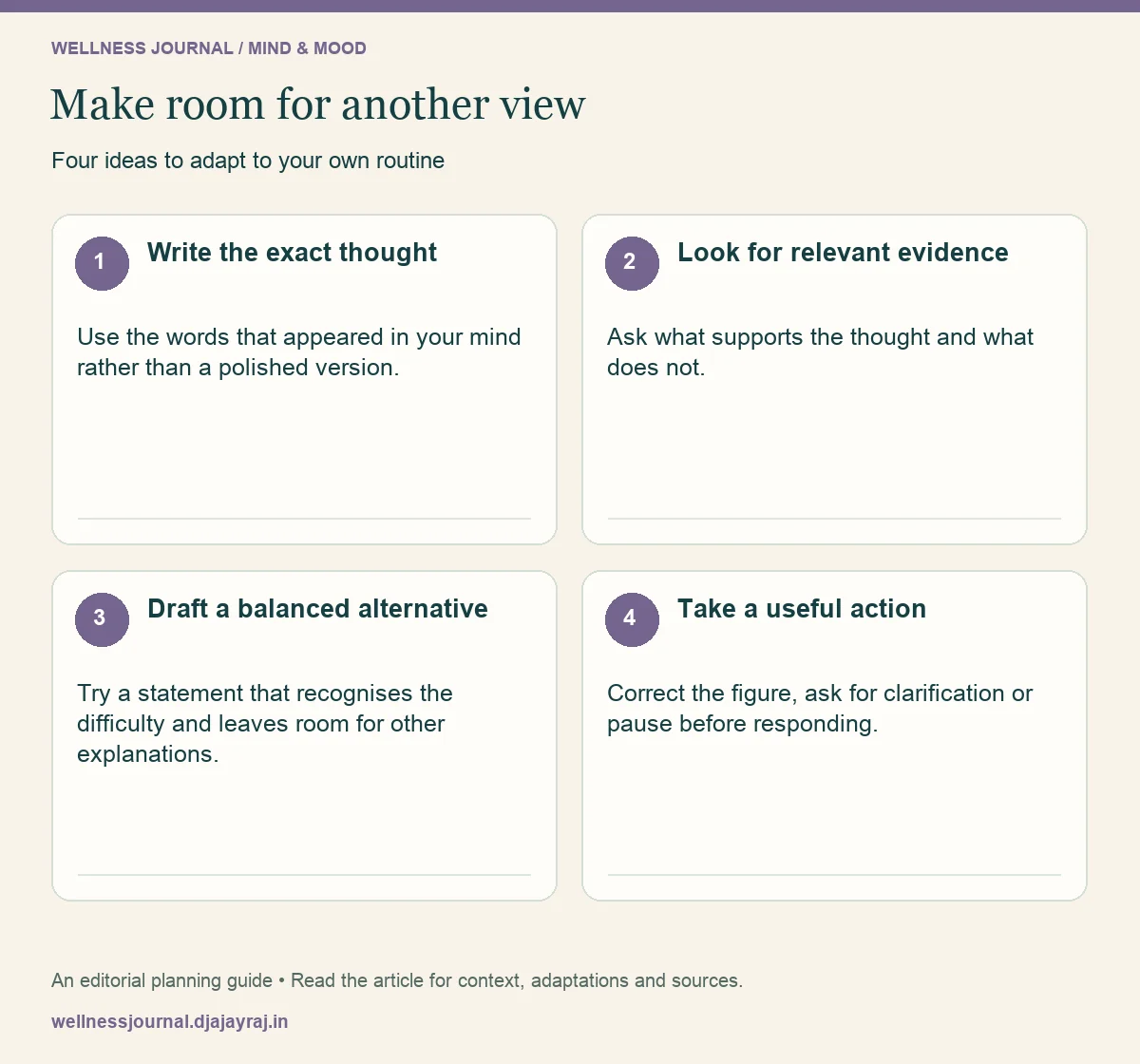
Write the exact thought
Use the words that appeared in your mind rather than a polished version. Notice absolute language such as always or never. Those words may be worth examining, but do not use them as a reason to dismiss your experience.
Look for relevant evidence
Ask what supports the thought and what does not. Include context such as workload, timing or information you do not have. Avoid inventing reassuring evidence simply because you want the thought to feel better.
Draft a balanced alternative
Try a statement that recognises the difficulty and leaves room for other explanations. For example, 'I made an error, and I can correct the figure' is more grounded than 'I never make mistakes.' Choose wording you can reasonably believe.
Take a useful action
Correct the figure, ask for clarification or pause before responding. A practical action can matter more than finding the perfect sentence. If no action is available, you can acknowledge uncertainty without continuing the debate indefinitely.
From a broad conclusion to a balanced view
| Initial thought | Question | Possible alternative |
|---|---|---|
| I always get it wrong | Is always accurate? | This part needs correcting |
| They must be annoyed | What do I actually know? | There may be other reasons |
| The whole day is ruined | Which parts are still open? | One difficult event happened |
| I cannot handle anything | What support or smaller step exists? | I can address one part |
Make it work for you
Do not use reframing to excuse harm
If someone has treated you unfairly or a situation is unsafe, a balanced view does not require minimising it. Practical protection, boundaries and support may be the appropriate response. If examining thoughts becomes exhausting or distressing, stop and consider professional help. A self-help exercise is not a requirement to manage every difficulty alone.
Use the voice of a fair observer
Ask what a thoughtful person with the same information might say. Aim for accuracy and kindness, not exaggerated praise. A believable sentence is more useful than one that feels false.
Quick checklist
- Use evidence rather than forced reassurance.
- Keep real problems visible.
- Choose a practical next step when possible.
Common questions
Does reframing mean positive thinking?
Not necessarily. A balanced interpretation may still acknowledge sadness, uncertainty or a genuine problem.
What if I cannot believe the alternative thought?
Make it more modest and accurate, or leave the exercise for now. You do not need to force yourself to accept a statement.