Two people can walk at the same speed and experience very different levels of effort. The exercise talk test gives you a practical way to notice how hard an aerobic activity feels for you. It is especially useful when you are learning a routine and do not want a device to make every decision. It remains a rough guide, not a medical test.
Use a familiar sentence as a check
Choose an ordinary sentence you can say without rushing. During a walk or another familiar aerobic activity, speak it aloud and notice whether you need unusual pauses. You are checking your breathing, not performing a speech exercise. If talking itself is difficult for you, use an alternative effort guide recommended by a qualified professional.
CDC guidance describes moderate activity as an effort at which you can talk but not sing; vigorous effort allows only a few words before pausing for breath.
Background guidance: CDC: Measuring physical activity intensity; NHS: Walking for health.
Four practical steps
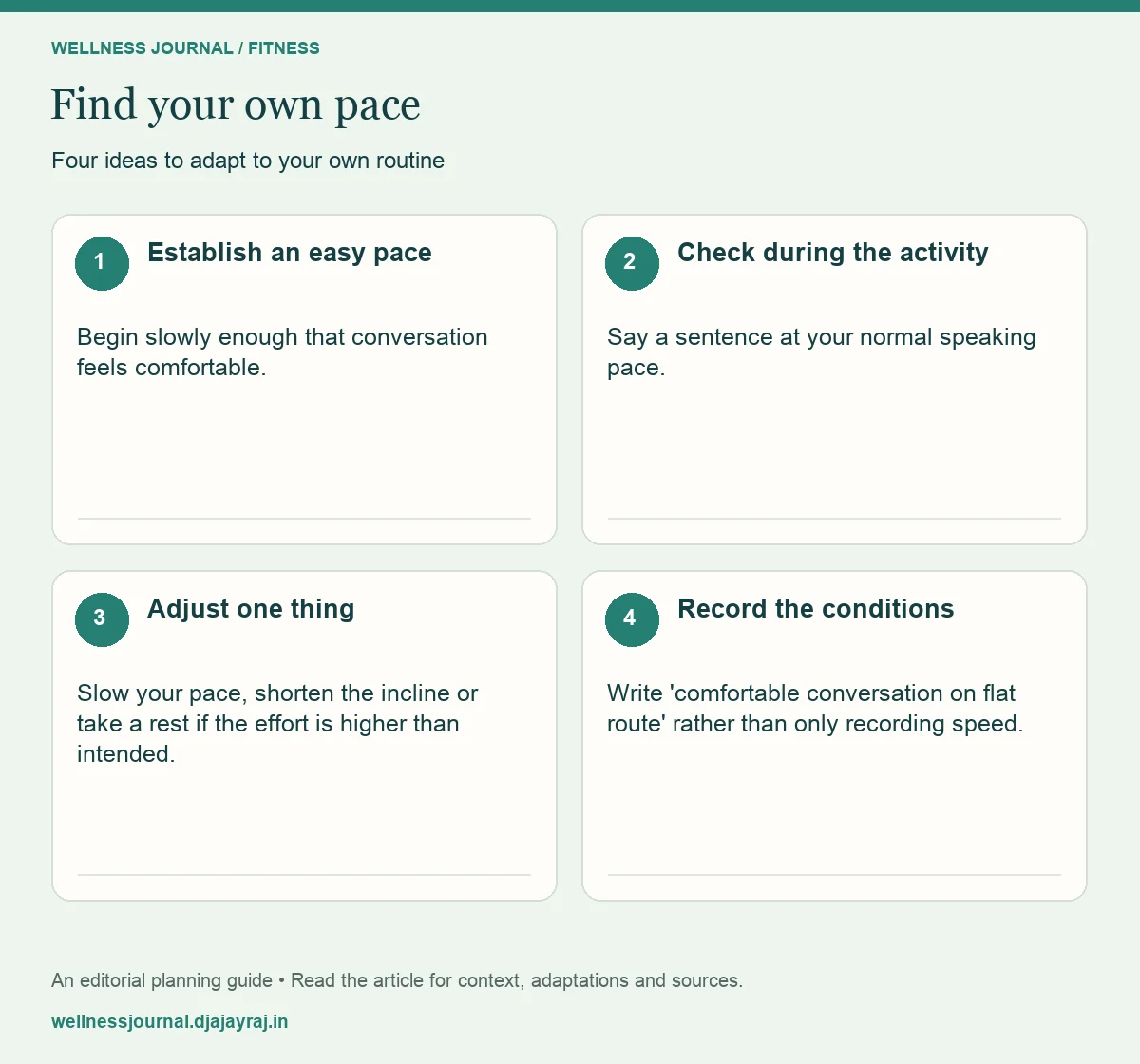
Establish an easy pace
Begin slowly enough that conversation feels comfortable. Give yourself time to settle into the activity before judging it. Hills, heat, fatigue and carrying a bag can all change how the same route feels.
Check during the activity
Say a sentence at your normal speaking pace. If it is easy to talk but singing would be difficult, you may be around a moderate effort. Do not force a song or hold your breath to test yourself.
Adjust one thing
Slow your pace, shorten the incline or take a rest if the effort is higher than intended. If everything feels easy and you want a little more challenge, make a small change and check again. You do not need to seek vigorous effort.
Record the conditions
Write 'comfortable conversation on flat route' rather than only recording speed. This gives context for later sessions. A slower walk in hot weather may feel harder than a faster walk on a cool day.
What your speech may tell you
| Speech pattern | Possible effort | Practical response |
|---|---|---|
| Easy conversation | Light or comfortable | Useful for an easy session |
| Talk, but singing is difficult | Often moderate | Maintain if comfortable |
| Only a few words at a time | Often vigorous | Slow if this was not intended |
| Unexpected breathing difficulty | Not a training target | Stop and assess symptoms |
Make it work for you
Know when the test is not enough
Breathing conditions, medications, pregnancy and other health factors can affect exercise response. Follow personal medical advice rather than a general rule. The talk test also does not tell you whether a movement is safe for an injured joint. Chest pain, faintness or severe unexpected breathlessness need attention, regardless of what a watch or effort score says.
Use it with a walking partner
Agree that the conversation pace will follow the person who needs the easier effort. A shared walk should not require someone to hide discomfort to keep up. Choose a route with places to stop.
Quick checklist
- Compare with your own usual effort.
- Recheck when the terrain or weather changes.
- Use symptoms and professional advice alongside any intensity tool.
Common questions
Is the talk test accurate enough?
It is a practical general guide to relative aerobic effort. It does not replace medical assessment or specialised testing when those are needed.
Do I need a heart-rate monitor too?
Not necessarily for an ordinary comfortable walk. Some people find devices helpful, but the number should not override symptoms or individual guidance.