Balance practice should not feel like a dare. The best starting point is a clear space, reliable support and movements you can stop easily. These balance exercises at home are a gentle introduction for people who can already stand safely. If you have fallen, feel dizzy or struggle to stand, ask a clinician or physiotherapist for a suitable programme before trying unsupported exercises.
Set up the space before the movement
Use a fixed counter or another stable support that will not slide when you hold it. Remove loose rugs and clutter, and choose secure footwear. Avoid practising beside sharp furniture edges or while holding hot drinks. Keep your eyes open. A video that asks you to close your eyes or stand on a soft cushion may be inappropriate for your starting level.
The NHS recommends having a wall or stable chair nearby during balance exercises and building practice gradually.
Background guidance: NHS: Balance exercises; NHS: Strength and flexibility.
Four practical steps
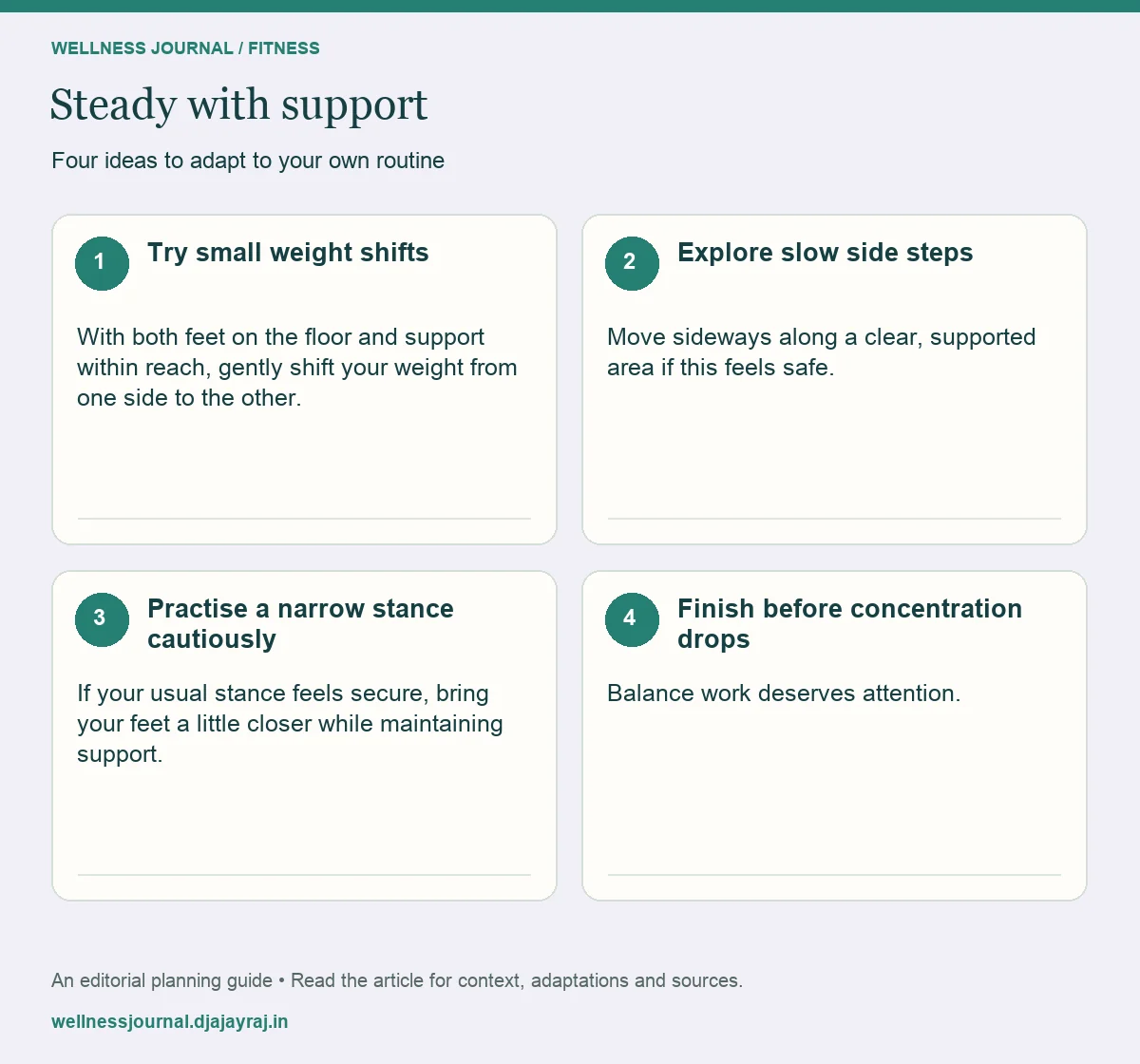
Try small weight shifts
With both feet on the floor and support within reach, gently shift your weight from one side to the other. Keep the movement small. The goal is to feel controlled, not to lean as far as possible.
Explore slow side steps
Move sideways along a clear, supported area if this feels safe. Step one foot out, then bring the other toward it without rushing. Keep the steps modest and avoid crossing your feet while learning.
Practise a narrow stance cautiously
If your usual stance feels secure, bring your feet a little closer while maintaining support. You do not have to progress to a tight heel-to-toe position. A smaller change can provide enough practice.
Finish before concentration drops
Balance work deserves attention. Stop when you feel tired or less steady, and sit down if needed. Record which support and stance felt comfortable so your next practice begins at a familiar level.
Adjust the challenge without losing support
| Starting point | Possible adjustment | Keep constant |
|---|---|---|
| Wide comfortable stance | Slightly narrower stance | Stable support |
| Small weight shifts | A little more controlled movement | Both feet grounded |
| Short side steps | A few additional steps | Clear floor |
| Feeling unsteady | Return to easier position | Eyes open; support available |
Make it work for you
Treat falls as a reason for assessment
A fall or new balance problem can involve vision, medication, strength, the environment or other health factors. It should not automatically lead to a harder online balance routine. An individual assessment can identify what needs attention and whether an assistive device or home adjustment would help. General practice is most useful when it fits that advice.
Make the support easy to reach
Arrange the practice so you never need to lunge for a chair. If a support cannot bear your weight reliably, choose another location. Having someone nearby does not make unstable furniture safe.
Quick checklist
- Keep eyes open and the floor clear.
- Use fixed or stable support.
- Stop for dizziness, new weakness or unusual symptoms.
Common questions
Should I practise with my eyes closed?
Not as a beginner working alone. Removing visual information increases the challenge and may be unsuitable without professional supervision.
Is wobbling a sign of progress?
Not necessarily. You are looking for controlled practice within a safe range, not the largest wobble you can recover from.