Making decisions with uncertainty does not mean ignoring risks or rushing. It means noticing when more checking is no longer changing the choice. Start with a low-stakes decision you can revise. Major medical, legal or financial decisions may require qualified advice and more careful analysis. A general wellbeing exercise should not replace that process.
Define the decision at its actual size
Write the choice, the available options and when an answer is needed. Separate the immediate decision from every possible future consequence. Choosing a weekend activity is not the same as choosing a career. The amount of research and certainty you seek should be proportionate to the stakes and reversibility.
NHS self-help resources distinguish practical problems from hypothetical worries. Some uncertainty remains even after reasonable information gathering.
Background guidance: NHS: Tackling your worries; NHS: Reframing unhelpful thoughts.
Four practical steps
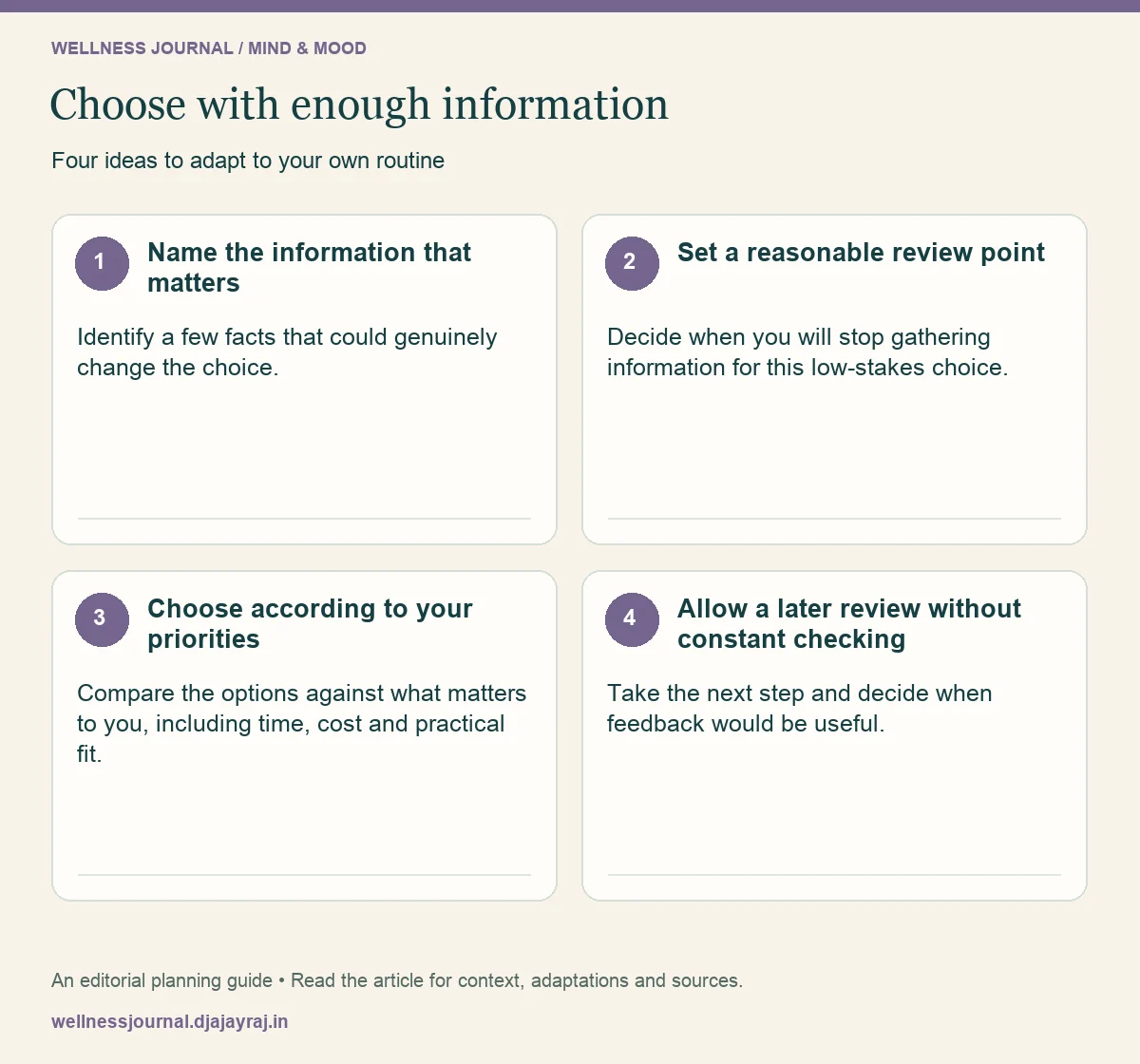
Name the information that matters
Identify a few facts that could genuinely change the choice. Use reliable sources and relevant advice. Avoid collecting more material simply because searching feels safer than deciding.
Set a reasonable review point
Decide when you will stop gathering information for this low-stakes choice. If important new evidence appears, you can revise the plan. A stopping point is not a promise to ignore reality.
Choose according to your priorities
Compare the options against what matters to you, including time, cost and practical fit. There may be more than one acceptable choice. You do not always need to identify a uniquely perfect option.
Allow a later review without constant checking
Take the next step and decide when feedback would be useful. Reopening the decision every few minutes can prevent you from learning from the actual experience.
Match the process to the decision
| Decision type | Useful approach | Extra care |
|---|---|---|
| Low stakes and reversible | Small trial | Review what happened |
| Moderate practical impact | Relevant facts and comparison | Check constraints |
| Medical, legal or financial | Qualified advice as needed | Do not use a generic shortcut |
| Repeated anxious checking | Notice whether information changes | Seek support if disruptive |
Make it work for you
Keep uncertainty from becoming a character judgement
Feeling unsure does not mean you are incapable. Some decisions are genuinely ambiguous. You can choose a reasonable option and still feel discomfort. If uncertainty leads to persistent distress, compulsive checking or major disruption, professional support can help you find a more workable response.
Try a small reversible experiment
Choose an option you can safely test, such as a routine time or a leisure format. Use the experience as information instead of expecting certainty before beginning.
Quick checklist
- Match research to the stakes.
- Use qualified advice for high-impact choices.
- Avoid treating discomfort as proof of a wrong decision.
Common questions
Should I always trust my first instinct?
No. Use relevant information and context. The goal is proportionate decision-making, not an automatic rule about intuition.
What if I regret a small choice?
Review what you learned and adjust where possible. A less-than-perfect outcome does not mean the process was unreasonable.