Learning how to ask for support can start with an unfinished sentence. You do not have to explain your entire situation perfectly before contacting someone. A small clear request gives the other person a way to respond. Choose someone appropriate and remember that a friend's care is valuable without making them responsible for providing every kind of help.
Decide what kind of support would help now
You may want listening, advice, company or a specific practical task. Those are different requests. If you are unsure, you can say so. A person may be willing to help but not know whether to offer solutions or simply stay present. Naming the type of support can reduce that mismatch.
NIH and NIA resources emphasise supportive connection. Support can include practical help, companionship and professional care, depending on the need.
Background guidance: NIH: Social wellness toolkit; NIA: Staying connected.
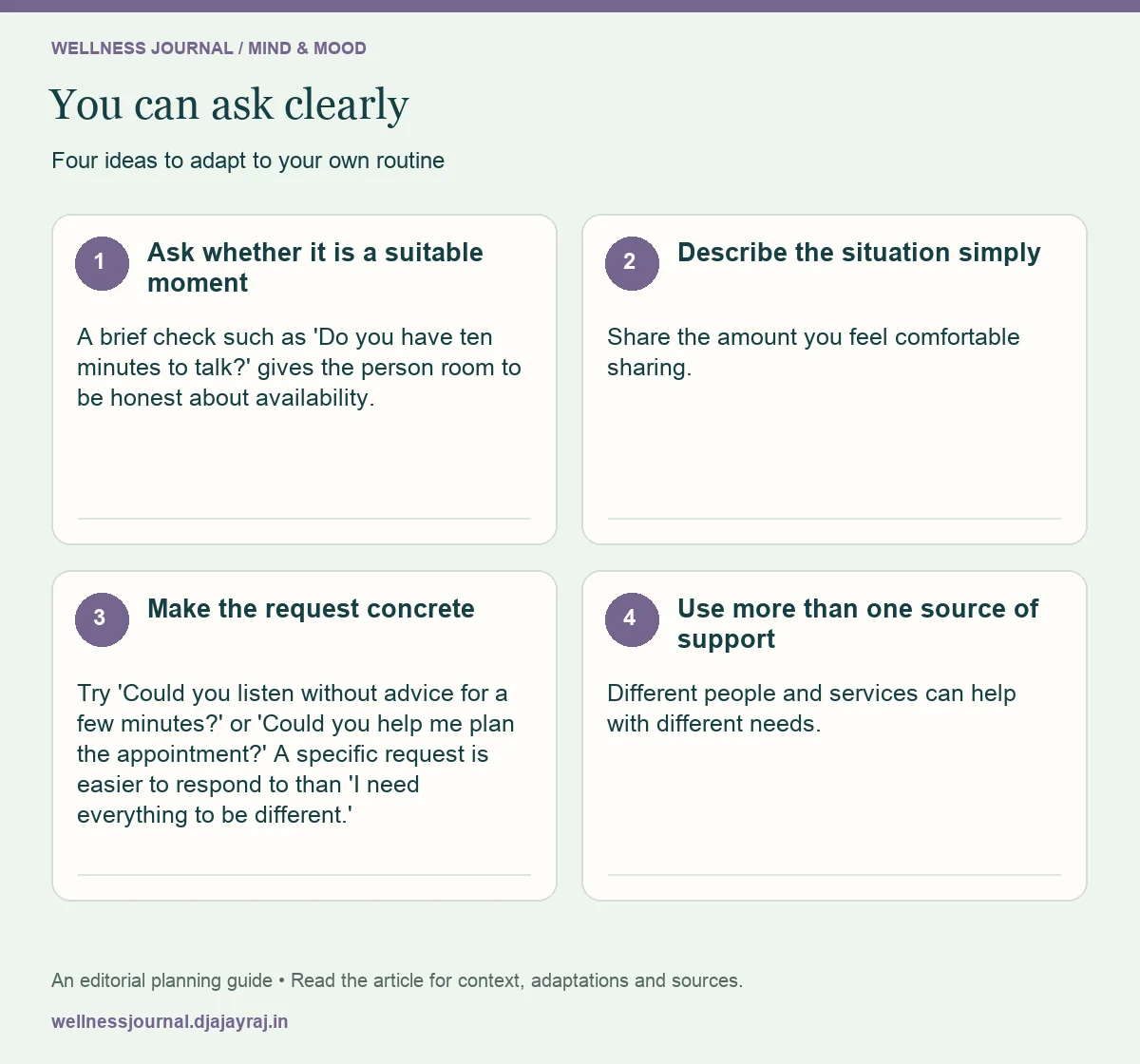
Four practical steps
Ask whether it is a suitable moment
A brief check such as 'Do you have ten minutes to talk?' gives the person room to be honest about availability. If they cannot talk now, ask about another time or contact a different suitable person.
Describe the situation simply
Share the amount you feel comfortable sharing. You can say that the week has been difficult without presenting a complete history. Keep private details limited to what is useful and what you trust the person to receive.
Make the request concrete
Try 'Could you listen without advice for a few minutes?' or 'Could you help me plan the appointment?' A specific request is easier to respond to than 'I need everything to be different.'
Use more than one source of support
Different people and services can help with different needs. A friend may offer company while a clinician provides assessment. If the first person cannot help, that does not mean the need is invalid or that support is unavailable.
Match the words to the support you need
| Need | Possible request | What it clarifies |
|---|---|---|
| Listening | Could you listen for a few minutes? | No immediate solution required |
| Practical help | Could you help me organise this task? | A specific action |
| Company | Would you sit or walk with me? | Presence |
| Professional care | Can you help me find an appointment? | A next step toward care |
Make it work for you
Use urgent support for urgent situations
If you feel at immediate risk of harming yourself or someone else, or cannot keep yourself safe, contact local emergency services or a crisis service now. Do not wait for an ordinary social reply. For persistent distress, a qualified mental-health professional can help you understand options beyond informal support.
Send a short opening message
Try 'I have been having a difficult week. Could we talk when you have a little time?' You can explain more during the conversation. The first message only needs to open a door.
Quick checklist
- Choose an appropriate person or service.
- Name the kind of help you want.
- Use urgent services when safety is at risk.
Common questions
What if I do not know what I need?
You can say that and ask for a brief conversation. Together you may identify a practical next step.
What if someone says they cannot help?
Their capacity is not a judgement of your need. Try another trusted person or an appropriate professional service.