The worry time technique gives recurring concerns a place in the day instead of asking you to solve each one whenever it appears. It does not mean your worries are unimportant or that you should suppress every thought. You briefly note the concern and return to it at a planned time. If this approach increases distress or becomes another ritual you feel compelled to perform, seek guidance.
Choose a short period with a clear ending
Pick a time when you can write or think without rushing immediately into another demand. Avoid turning it into an open-ended evening analysis session. Use a simple note for concerns that appear earlier. The note only needs enough detail to recognise the worry later; you do not need to build a complete argument each time.
NHS self-help guidance describes setting aside worry time and distinguishing practical problems from hypothetical concerns. It is one option, not a universal solution.
Background guidance: NHS: Tackling your worries; NIMH: Caring for your mental health.
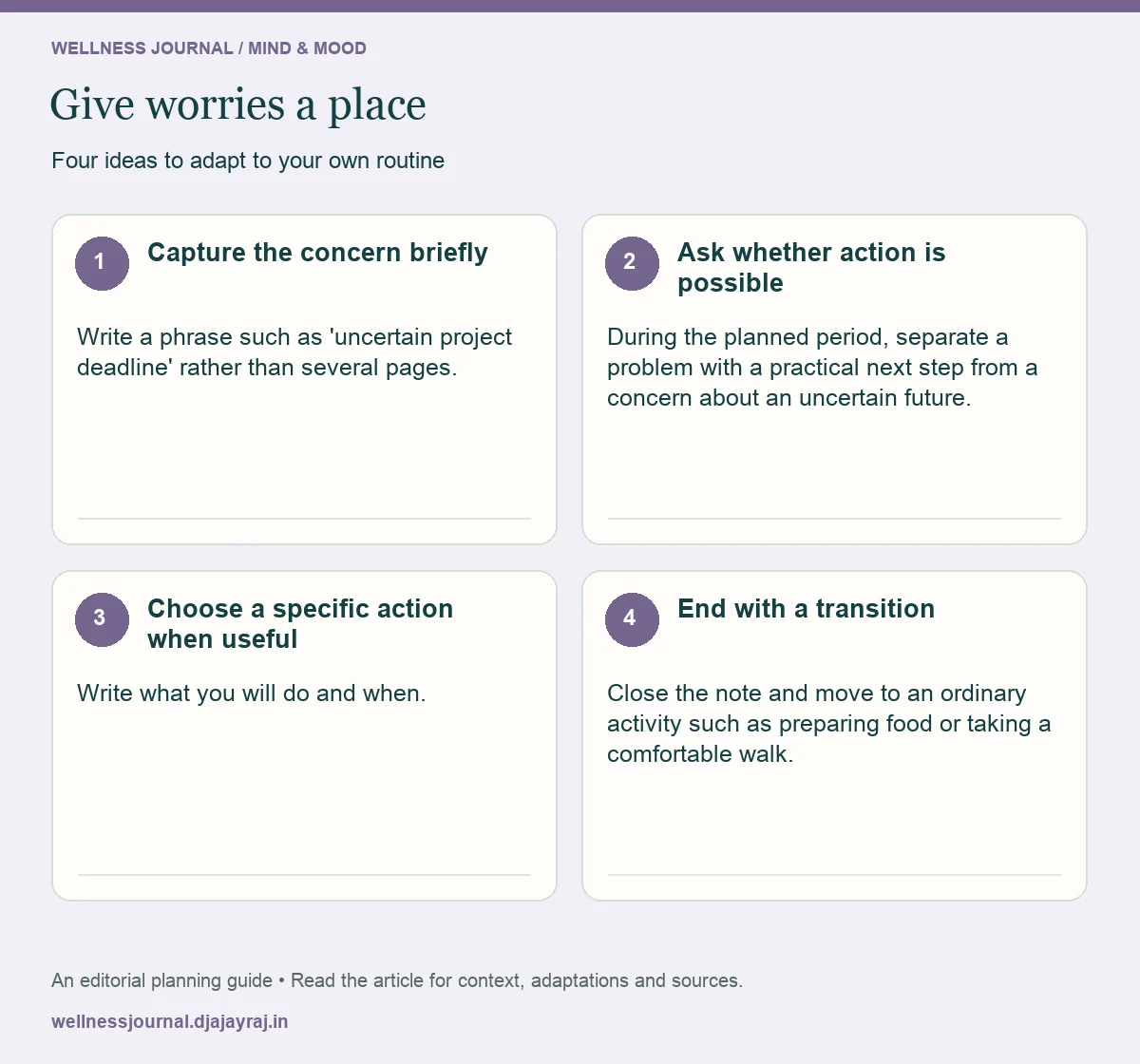
Four practical steps
Capture the concern briefly
Write a phrase such as 'uncertain project deadline' rather than several pages. Remind yourself that you have a planned opportunity to consider it. Then return attention to the current task as gently as you can.
Ask whether action is possible
During the planned period, separate a problem with a practical next step from a concern about an uncertain future. You may be able to ask a question or make a plan. Other worries may not be solvable today.
Choose a specific action when useful
Write what you will do and when. Keep it within your control. Repeatedly researching the same uncertainty may not be a useful action, especially if it leaves you more distressed without changing the situation.
End with a transition
Close the note and move to an ordinary activity such as preparing food or taking a comfortable walk. The ending does not require complete certainty. It marks the end of this particular thinking period.
Sort the concern without demanding certainty
| Type of concern | Useful question | Possible response |
|---|---|---|
| Practical problem | What can I do next? | Choose one action |
| Missing information | Who can clarify this? | Ask a focused question |
| Hypothetical future | Is there action available now? | Acknowledge uncertainty |
| Repeated distress | Is this method helping? | Adapt or seek support |
Make it work for you
Keep the technique optional
Some people prefer a different approach, such as talking with a trusted person or working with a therapist. You do not need to persist with a self-help tool that makes you feel worse. If worry is persistent, hard to control or affecting sleep, work or relationships, professional support can help you understand what is happening.
For a worry that returns immediately
Notice it, refer to the brief note and return to the present activity. Avoid scolding yourself for having the thought again. Repetition is not proof that you failed the exercise.
Quick checklist
- Keep notes brief.
- Separate action from uncertainty.
- Use a clear stopping point and seek help when needed.
Common questions
Am I supposed to stop worrying completely?
No. The aim is to change how you respond to recurring concerns, not to eliminate every worried thought.
What if the worry is urgent?
Take appropriate action for a genuinely urgent problem. A scheduled thinking period should not delay safety-related or time-sensitive decisions.