A five minute journal can give a busy mind somewhere to put unfinished thoughts. It does not need beautiful handwriting, a special notebook or a full account of the day. Use a short structure that helps you distinguish what happened, what is on your mind and what you want to do next. Stop if writing makes you feel more distressed or trapped in repeated analysis.
Keep observation separate from interpretation
Begin with a concrete event: a meeting ran late, you missed a train or a friend sent a kind message. Then describe your reaction in ordinary words. This separation can make the page easier to understand. You are not trying to prove that your feelings are right or wrong, and you do not need to find a lesson in every experience.
Wellbeing resources include reflection and practical ways to address worries. This journal format is an editorial exercise, not a diagnostic or therapy tool.
Background guidance: NIH: Emotional wellness toolkit; NHS: Tackling your worries.
Four practical steps
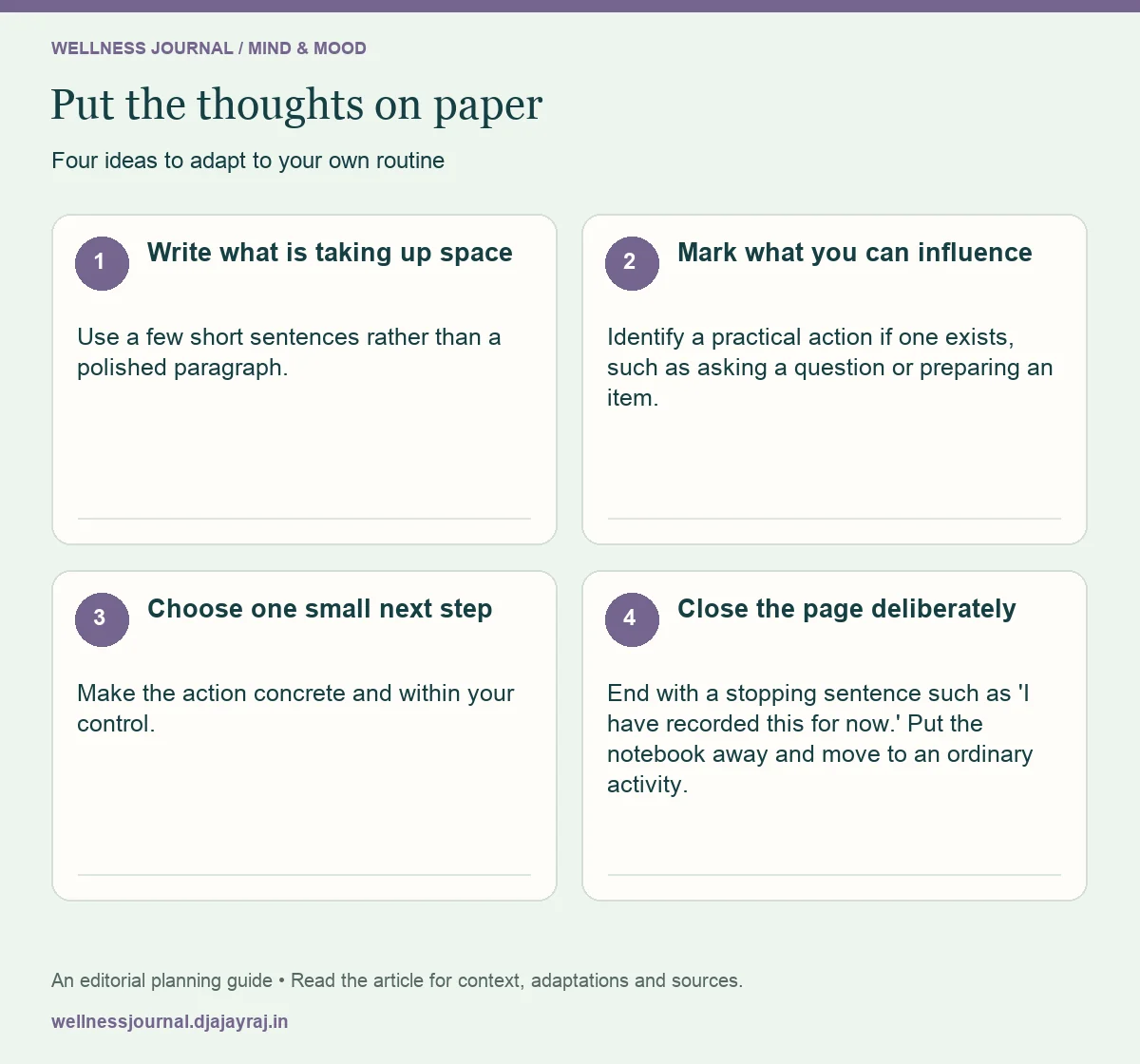
Write what is taking up space
Use a few short sentences rather than a polished paragraph. Name the concern or feeling as clearly as you can. If there are many thoughts, choose the one that seems most relevant now.
Mark what you can influence
Identify a practical action if one exists, such as asking a question or preparing an item. Some concerns do not have an immediate solution. You can acknowledge that without inventing a task simply to make the page feel complete.
Choose one small next step
Make the action concrete and within your control. 'Send a question about the deadline' is clearer than 'stop worrying about work.' If the useful next step is rest or asking for support, write that plainly.
Close the page deliberately
End with a stopping sentence such as 'I have recorded this for now.' Put the notebook away and move to an ordinary activity. A journal session does not need to continue until every thought has disappeared.
A short page you can reuse
| Prompt | What to write | Example |
|---|---|---|
| What happened? | A concrete observation | The deadline changed |
| What am I noticing? | A feeling or concern | I feel rushed |
| What can I influence? | A practical part | Clarify the priority |
| What is next? | One manageable action | Ask one question tomorrow |
Make it work for you
Protect privacy and emotional comfort
Choose a storage method that feels private enough for the material. Avoid putting sensitive details in a shared document by accident. If a topic brings up trauma or intense distress, you do not have to explore it alone in a journal. Professional support can help you decide whether and how writing fits your care.
Use a one-line version
Write 'What matters now is…' and finish the sentence. Then add one useful next action if appropriate. A short entry is still a complete entry.
Quick checklist
- Keep the format brief.
- Distinguish an observation from a conclusion.
- Stop and seek support if writing increases distress.
Common questions
Do I need to journal every day?
No. Use it when helpful. A missed entry does not reduce the value of an earlier one.
Is journaling a replacement for therapy?
No. It can be a personal reflection tool, but persistent or severe distress may need professional care.