The best Idaho clinic for sinus lift surgery is the one that can explain why the procedure is needed, offer appropriate alternatives, coordinate the eventual dental restoration, and provide a clear plan for cost and follow-up. There is no universal ranking that identifies the right surgeon for every patient. A clinic’s advertisement or a low quoted graft fee cannot answer all of those questions.
This guide uses verified local service examples and transparent selection criteria. The practices are unranked, and their inclusion does not establish comparative outcomes, current appointment availability, or insurance participation. Ask for an individualized examination and treatment plan before deciding where to proceed.
Understand what a sinus lift is intended to accomplish
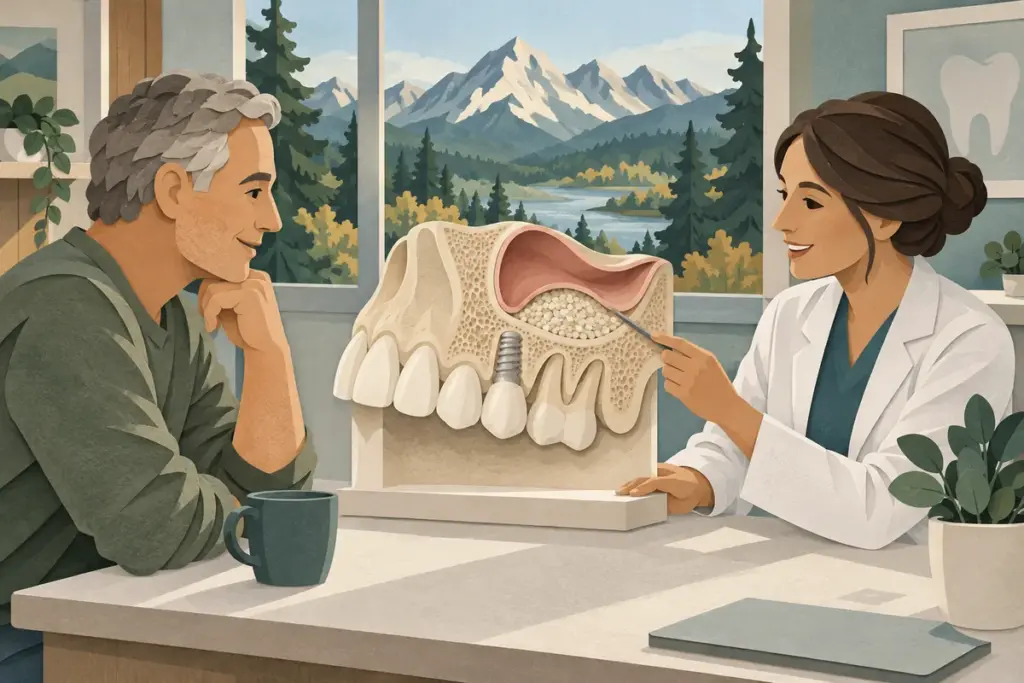
A sinus lift, also called sinus augmentation, may be considered when the upper back jaw does not have sufficient bone for a proposed dental implant. The American Academy of Periodontology explains that the procedure raises the sinus floor and develops bone for implant placement. Different techniques are available, and the appropriate approach depends on the individual situation.
Not every missing upper tooth requires a sinus lift. Ask the clinician to show you the imaging findings and explain the relationship between available bone, sinus anatomy, and the intended restoration. Discuss whether another implant approach or a different tooth-replacement option is reasonable. The decision should start with the desired dental result, not simply the availability of a grafting procedure.
The periodontology academy also explains that implants may sometimes be placed at the same time as augmentation, while other cases require a separate healing period first. Ask which sequence is proposed for you, what could change it, and how the team will decide that the site is ready for the next stage. Do not assume a single-visit implant advertisement applies to your anatomy.
Connect the surgery to the finished tooth replacement
Identify who is responsible for the graft, implant placement, and final crown or other restoration. Those steps may involve different clinicians and separate fees. Ask how the restorative dentist and surgeon will agree on the position and timing of treatment.
Request one shared plan
The plan should identify the intended tooth or teeth, proposed stages, responsible practices, and checkpoints before proceeding. Ask which parts remain uncertain until examination or imaging is complete.
Confirm the handoff
Find out who sends records to the next clinician and who contacts you when it is time to schedule the next stage.
Use verified Idaho examples as a starting list
These practices explicitly describe sinus augmentation or related grafting services on their own websites. They offer a starting point for consultation, not a complete directory or a claim that one practice is better than another. Verify the current office, clinician, procedure location, and availability directly.
| Practice | Location context | Service information to discuss |
|---|---|---|
| Idaho Oral Surgery | Fruitland | Sinus lift and bone grafting for implant preparation |
| Eagle Oral Surgery and Implant Center | Eagle | Sinus lift within its bone grafting services |
| IdahoPerio | Boise and Meridian practice locations | Oral surgery information describing sinus grafting |
Idaho Oral Surgery’s sinus lift page describes augmentation for the upper posterior jaw and the relationship between grafting and implant placement. Ask which surgeon would evaluate you and whether the proposed operation and follow-up would occur at the Fruitland office.
Eagle Oral Surgery and Implant Center publishes a dedicated sinus lift service page. Use the consultation to clarify the technique, graft material, staging, and how its surgical plan will be coordinated with the dentist making the final restoration.
IdahoPerio’s oral surgery information describes sinus membrane elevation and bone graft placement for implant support. Its practice serves the Boise and Meridian area; confirm which location offers your proposed care rather than assuming every service is performed at every office.
These descriptions verify advertised service scope only. They do not independently establish a clinician’s current credentials, personal case experience, complication rate, or suitability for your case. Ask each prospective practice the same questions so your comparison is based on meaningful answers.
Evaluate the consultation, not just the equipment
Ask the clinician to explain the diagnosis and why the proposed treatment is preferred. Request a discussion of alternatives, expected benefits, important risks, and the consequences of postponing treatment. If the explanation remains unclear, ask for a written summary or another consultation before committing to a nonurgent procedure.
Bring your medical and dental history, current medicines, allergies, prior dental imaging, and information about previous sinus problems or surgery. Ask whether another clinician should assess any active sinus concern before dental treatment. Do not assume that an implant consultation replaces evaluation of a separate nasal or sinus condition.
- Ask about the surgeon’s training and experience with the proposed technique.
- Discuss the source of graft material and available alternatives.
- Ask what findings would change or postpone the plan.
- Clarify the anesthesia or sedation options and their separate requirements.
- Request instructions for preparation, recovery, and urgent contact.
Imaging and technology can support planning, but possession of a particular scanner does not establish that a clinic is the best fit. Ask what the images show, how they affect treatment, and whether existing studies can be used. Avoid paying for duplicate testing merely because records were not transferred in time.
Discuss what happens if the planned graft or implant cannot proceed as expected. Who explains the new options? Which fees might change? How would another specialist become involved? A clear response to uncertainty is more useful than a promise that complications will never occur.
Compare the complete price and insurance terms
Request an itemized estimate for the whole proposed sequence, not only the sinus lift. Ask whether consultation, imaging, graft material, membrane or other supplies, anesthesia, follow-up, implant placement, abutment, and final restoration are included. If different practices participate, obtain estimates from each and identify any services not yet priced.
Use the same treatment scope when comparing proposals. A quote for grafting alone cannot fairly be compared with a quote that includes the implant and crown. Ask how staged treatment is billed, when deposits are due, and what happens to prepaid amounts if the clinical plan changes.
Dental and medical insurance are separate benefit questions. Do not assume that a sinus-related procedure will be covered by medical insurance or that implant preparation is covered by a dental policy. Have the practice provide the proposed codes and clinical documentation, then ask each relevant insurer for the applicable benefit rules.
The American Dental Association explains preauthorization and predetermination and their limits. An advance response is not an unconditional guarantee of payment: eligibility, available benefits, or the eventual treatment details may affect the claim. Ask what the insurer has actually approved and what remains your responsibility.
Review deductibles, coinsurance, exclusions, waiting periods, and annual benefit limits using your actual policy. The ADA’s dental plan comparison guidance is a useful reminder to examine those terms. Ask how earlier dental claims have reduced the benefit still available and whether a later treatment stage falls in a different benefit year.
If financing is offered, compare the total repayment obligation, interest terms, and consequences of missing a promotional deadline. Keep the decision about clinical suitability separate from the monthly payment amount. Ask about financial arrangements only after the treatment scope is understandable.
Plan recovery around your actual instructions
Before scheduling, ask how the proposed procedure could affect work, travel, eating, activity, and caregiving. If sedation is planned, confirm escort and transportation requirements. Arrange help based on the practice’s instructions rather than assuming you can drive yourself or return immediately to every normal activity.
Obtain written postoperative guidance covering medicines, oral hygiene, sinus precautions, follow-up, and signs that require a call. Ask the clinician to explain any restrictions and their duration for your procedure. Do not adopt another patient’s recovery timetable or change a prescribed medicine without advice from the treating team.
Know which telephone number works after hours and where to seek care if the office is closed. Ask what to do if you develop a new sinus illness before surgery or a concerning symptom during recovery. Report changes promptly according to the practice’s instructions rather than waiting for the next scheduled implant appointment.
Before the final restoration begins, ask who confirms that the surgical site is ready and how that decision is documented. Keep copies of the treatment plan and implant information for future dental care. Long-term maintenance should be part of the discussion from the beginning, including which practice will provide routine reviews.
If two clinicians recommend different approaches, request the reasoning behind each plan and ask whether they are working from the same images and restorative goals. Differences in staging or graft choice deserve explanation, not an assumption that the more expensive option is better. A second opinion is most useful when the clinician can review the original findings and identify the specific decision that remains uncertain.
Choose the question your consultation must answer
This worksheet has no submission and no saved state. It does not diagnose your needs or rank clinics. Bring your selected question to a qualified clinician and ask for an answer tied to your examination, proposed treatment, and practical circumstances.
