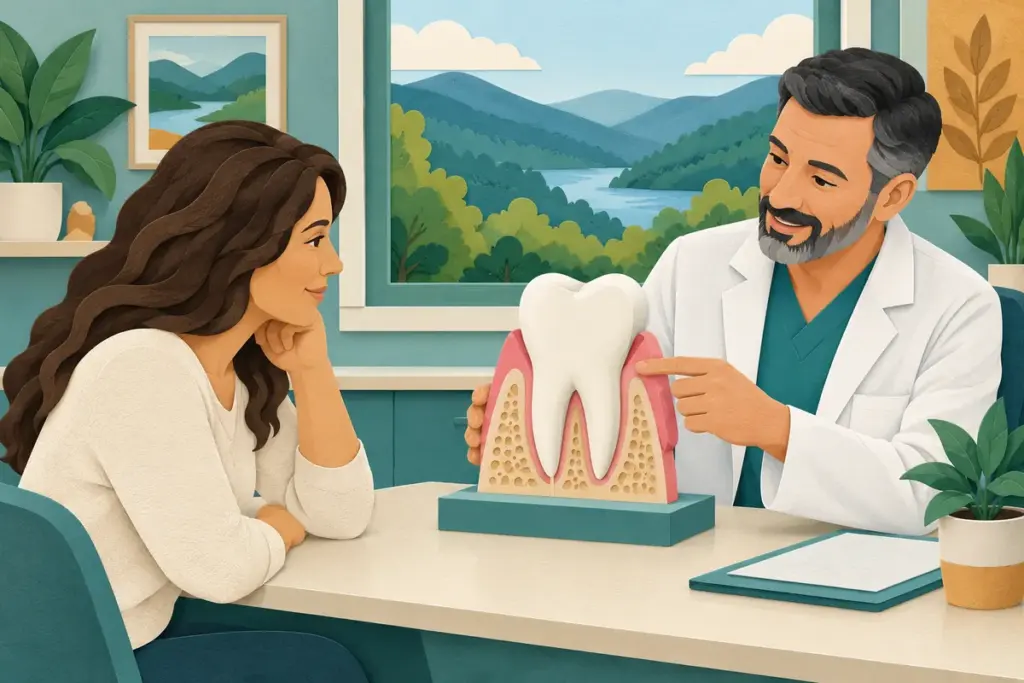
The best Arkansas dental clinic for gum graft surgery is the one that can explain why grafting is appropriate for your teeth, offer a suitable technique, and provide dependable postoperative care. There is no universal ranking that identifies that clinic for every patient. Compare periodontal expertise, the diagnosis behind the recommendation, the proposed graft, follow-up access, and the complete cost rather than choosing from advertisements or a list of unexplained “top” practices.
This guide identifies two Arkansas practices whose own websites describe gum grafting and provides a practical comparison method. Their inclusion verifies a service claim, not superior results, current insurance participation, or suitability for you. No numerical ranking is assigned.
First establish what the graft is intended to accomplish
The American Academy of Periodontology’s surgical-procedure guide describes gum grafting as transferring tissue from the palate or another donor source to address exposed roots. Depending on the situation, grafting may help with sensitivity or appearance. Ask your clinician to identify the objective for each proposed site rather than assuming every graft has the same purpose.
Ask which teeth are affected, how the condition was assessed, and what might happen with monitoring or other care. Discuss whether the goal is root coverage, additional tissue, easier maintenance, or another concern. The explanation should connect the examination to the treatment and acknowledge where full coverage or a particular cosmetic result may not be achievable.
Clarify the cause and the rest of the treatment plan
Ask whether the clinician has identified factors that need attention before or after surgery. Describe how you clean your teeth, any sensitivity, prior orthodontic treatment, restorations, and previous gum treatment. The periodontist should decide which details are relevant rather than you trying to diagnose the cause from photographs online.
Also ask whether other periodontal treatment should occur first and how grafting fits into your ongoing dental care. A procedure addresses a defined problem; it should not replace a clear maintenance plan. Knowing the sequence helps you understand why two clinics may recommend different timing even when they agree that a graft could be useful.
Verified Arkansas examples to investigate
| Practice | What its website establishes | What remains to be checked |
|---|---|---|
| Arkansas Periodontal and Implant Associates | A dedicated gum-grafting page describes several graft approaches and individualized selection. | Your consultation location, treating clinician, proposed technique, cost, and insurance |
| Pinnacle Periodontics and Dental Implant Center, Little Rock | The official practice page lists gum grafting within its periodontal services and gives a Little Rock office address. | Who performs the surgery, which services are appropriate, availability, and follow-up arrangements |
Arkansas Periodontal and Implant Associates’ gum-grafting page discusses connective-tissue, free-gingival, and pedicle approaches. These are provider descriptions, not evidence that every patient should have one or that the practice achieves better results than others. Ask which method is proposed for your site and why.
Pinnacle Periodontics and Dental Implant Center’s official website lists gum grafting among its services in Little Rock. Confirm the exact treating professional and plan directly. A broad service list does not tell you the price, the number of visits, or whether a particular insurer covers your treatment.
This is a starting list, not a complete directory of Arkansas providers. Your general dentist may suggest other appropriate periodontists. Include additional options that fit your location and compare them using the same questions. A clinic omitted here should not be interpreted as lower quality.
Verify professional credentials without relying on advertising
Ask for the name of the dentist who would perform the surgery and their relevant periodontal training. The Arkansas State Board of Dental Examiners page provides access to license verification. Check the current record using the professional’s identity rather than assuming that a clinic’s trading name identifies every practitioner.
Licensure is an important baseline, not proof of a particular outcome. Ask about experience with cases similar to yours, including the location and extent of recession and whether prior grafting has occurred. If a clinician describes a specialty qualification or certification, ask how it can be independently verified.
Ask about the individual case, not only procedure volume
A high total number of procedures may include very different situations. Ask how the clinician evaluates your site and what factors make the expected result more or less predictable. If photos are shown, ask whether they represent a comparable case and how long after treatment they were taken. Photos are examples, not guarantees.
Notice whether the clinician welcomes questions and describes uncertainty clearly. You should understand who will see you for follow-up and whether another professional covers the practice when your surgeon is away. The quality of that explanation is a useful comparison criterion even when you cannot compare formal outcome data.
Compare the proposed graft and donor material
Ask the clinician to describe where the graft tissue will come from and whether a separate donor area is involved. If donor material is proposed, ask why it is suitable, what alternatives exist, and whether it changes the estimate. Avoid assuming that a technique is better because it is described as newer, less invasive, or proprietary.
Request a tooth-by-tooth explanation if several areas are being considered. Are all sites equally important? Could they be treated together, or would separate appointments be preferable? Which goals are clinical and which are primarily cosmetic? These questions help prevent a single package price from hiding meaningful differences between sites.
Understand the risks and expected recovery
Ask the surgeon to explain the risks that matter for your medical history and the proposed method, including the possibility that the result may differ from the goal. Discuss how pain, bleeding, healing concerns, or an unsuccessful graft would be assessed. Obtain personalized instructions rather than using another practice’s online aftercare sheet.
- Provide a complete medication and supplement list and relevant health history.
- Ask whether sedation is planned and whether an escort is required.
- Clarify eating, cleaning, activity, and follow-up instructions for your procedure.
- Request daytime and after-hours contact information.
- Learn which changes require prompt advice and which require urgent assessment.
- Ask when your general dentist should resume routine care around the treated area.
Plan the early follow-up before choosing the date
Ask when the first review should occur and whether additional visits are likely. If you live far from the clinic, explain the travel time and any difficulty returning at short notice. A convenient surgical date is less useful if postoperative care cannot be accessed when needed.
Keep instructions accessible
Ask for written directions you can review with your support person. Keep them with the clinic’s contact details and medication instructions. If two instructions seem inconsistent, ask the office to clarify before acting. Do not change prescribed medicines on your own based on a generic dental checklist.
Get a complete cost estimate
Ask for an itemized estimate showing the examination, imaging if needed, surgical sites, graft material, anesthesia or sedation, and follow-up. Find out whether an additional donor site changes the charge and whether staged treatment generates separate fees. A quoted amount “per tooth” may not include every part of the episode.
| Estimate component | Question to resolve |
|---|---|
| Sites and goals | Do both estimates address the same teeth and treatment objectives? |
| Technique and material | Is the same approach proposed, and why does it differ if not? |
| Anesthesia or sedation | What is included, and is anything billed separately? |
| Follow-up | How many routine reviews are included and for what period? |
| Changes or complications | What services could create an additional charge? |
| Payment terms | What deposit, cancellation policy, and refund conditions apply? |
This article does not give an Arkansas average because a verified comparable local price dataset was not established. Request personalized quotes after examination. Comparing an online starting price with a full treatment estimate can create a misleading impression of savings.
Check dental insurance before paying a deposit
Ask the clinic for the proposed codes and request a benefit estimate when appropriate. The American Dental Association’s preauthorization guidance explains that predeterminations depend on eligibility and remaining benefits; final coverage can differ. Confirm the current policy, network status, and available benefits on the planned treatment date.
Ask whether the insurer treats the proposed service as covered periodontal treatment, applies a limitation, or excludes it. Find out how the allowed amount and annual benefit maximum affect your share. The office’s ability to submit a claim does not itself establish network participation or reimbursement.
If you are offered financing, compare the complete repayment terms separately from the treatment recommendation. Ask about interest, fees, payment dates, and what happens if treatment changes. Make sure you understand the clinical plan before turning a preliminary estimate into a binding financial commitment.
Use a second opinion when the plans differ
A second assessment can be useful if you do not understand the need for surgery, if extensive treatment is proposed, or if techniques differ substantially. Give both clinicians the same history and ask what explains the difference. Ask whether monitoring or another approach is reasonable and how quickly a decision should be made.
In a hypothetical comparison, one clinic recommends grafting several sites together while another proposes treating one area and reassessing. The lower initial price does not establish which plan is better. Compare the clinical goals, the reason for staging, the total expected visits, and the possibility of further treatment before deciding.
Write down the unresolved issue after each consultation. If the only remaining difference is convenience or communication style, that may legitimately influence your choice. If the disagreement concerns whether treatment is needed, resolve the clinical reasoning before focusing on small differences in price.
Look beyond the procedure to maintenance
Ask how the periodontist will communicate with your general dentist and how future examinations will assess the treated sites. Clarify who handles routine preventive care and who should evaluate a new concern. Keep copies of the treatment summary and relevant images if you later transfer practices.
A clinic that explains the long-term plan gives you a clearer basis for choosing than one that discusses only the surgical appointment. Your daily care, future dental treatment, and ability to return for review all belong in the conversation about maintaining the result.
Your Arkansas gum-graft clinic worksheet
This worksheet does not submit or save data and collects no information. Choose a temporary planning reminder; it does not select a clinic or recommend surgery.
The most suitable clinic is the one whose plan you understand and whose care you can realistically use. Combine verified professional information with an individualized recommendation, transparent costs, and reliable follow-up. Those criteria are more useful than an unsupported claim that any one Arkansas practice is universally best.
